A golf cart that cuts out mid-drive, stalls and restarts, or surges faster and slower on its own is more than an annoyance: it is a vehicle behaving unpredictably, sometimes near slopes, water or people. The good news is that intermittent faults follow patterns, and the pattern usually names the culprit: cutting out over bumps points to a loose connection, fading when warm points to the controller protecting itself, dying on hills points to a pack low under load, and surging points to the pedal sensor. This guide, equally at home under the American name golf cart, reads each pattern with you, and is honest that most of these faults need an engineer to finish the job.
- Stop somewhere safe and level first; investigate nothing while the cart can move.
- Cutting out over bumps almost always means a loose or corroded connection.
- Slowing when warm on long climbs is usually the controller's thermal protection, not a breakage.
- Surging or hunting speed points to the pedal (throttle) sensor.
- Dying under load but recovering at rest points to a low or tired pack.
First, note exactly when it happens
Before anything else, gather the pattern, because it is the single most useful thing you can give an engineer. Does it cut on acceleration, over bumps, on hills, or only once the cart has been working a while? Does it restart immediately, after a pause, or only after a rest? Does anything flash or beep when it happens? A short note, or a phone video with sound, often lets us arrive carrying the right part rather than diagnosing from scratch.
Cuts out over bumps: a connection
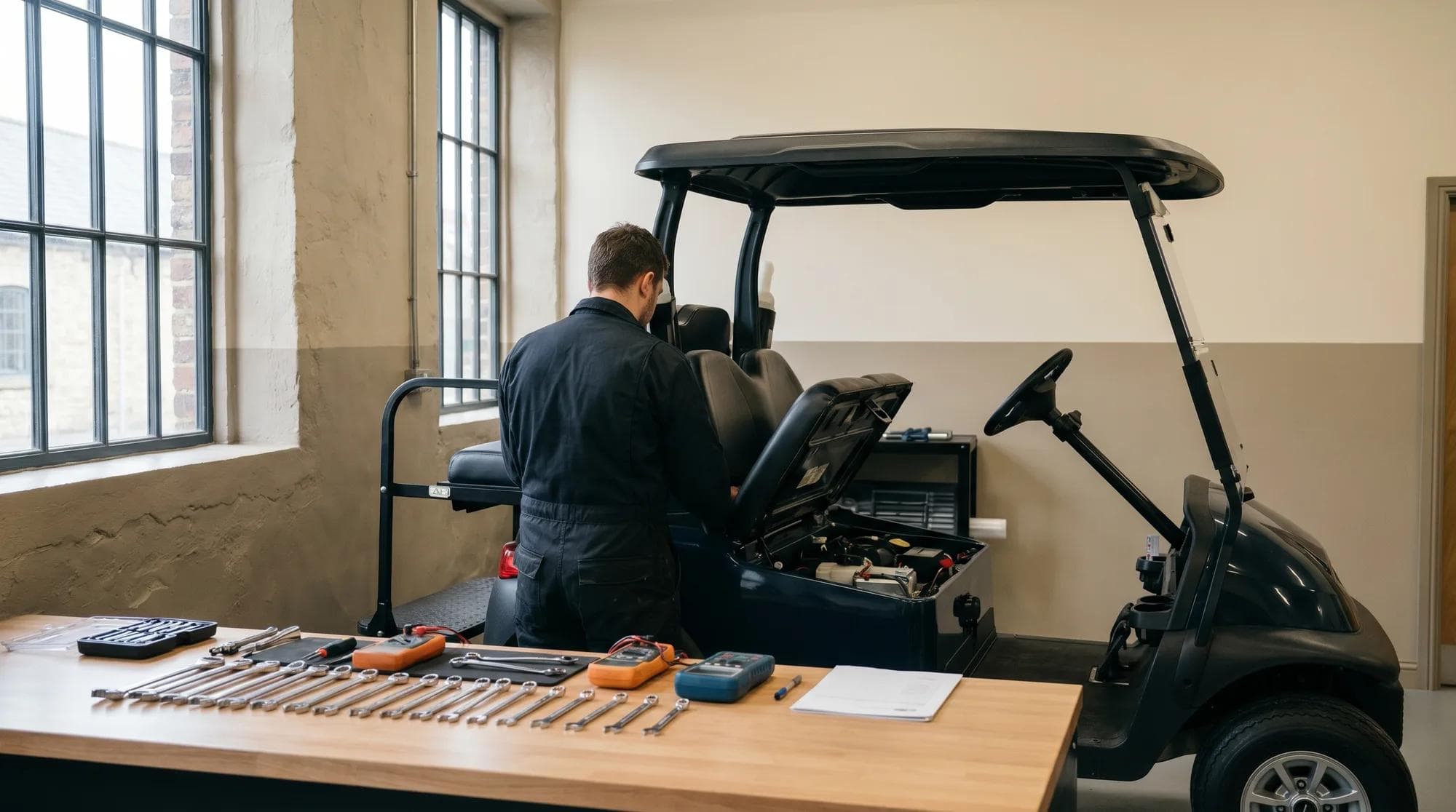
Power that drops for a moment when you hit a kerb, a sleeping policeman or rough ground is the signature of a loose connection: a battery terminal, an interconnect between batteries, or a plug vibrated loose. With the cart switched off and the key out, look for anything visibly loose, dirty or corroded at the main connections and the seat and charge-port plugs, and check gently for movement without forcing or disconnecting anything. Never undo high-current cables yourself; a connection that moves is a finding to report, not to fix at the roadside, because a poor joint also makes heat.
Slows down when warm: thermal cutback
A cart that pulls well when cold but grows sluggish on a long climb or a hard afternoon is often not broken at all: controllers and motors deliberately reduce power when they run hot, to protect themselves. Give it a few minutes to cool and see whether performance returns; if it does, that is protection working. But if cutback arrives on work the cart used to shrug off, something has changed: tire pressures, a dragging brake, extra load or a component on its way out, and it is worth a check before the protection becomes a habit.
Speeds up and slows down: the pedal sensor
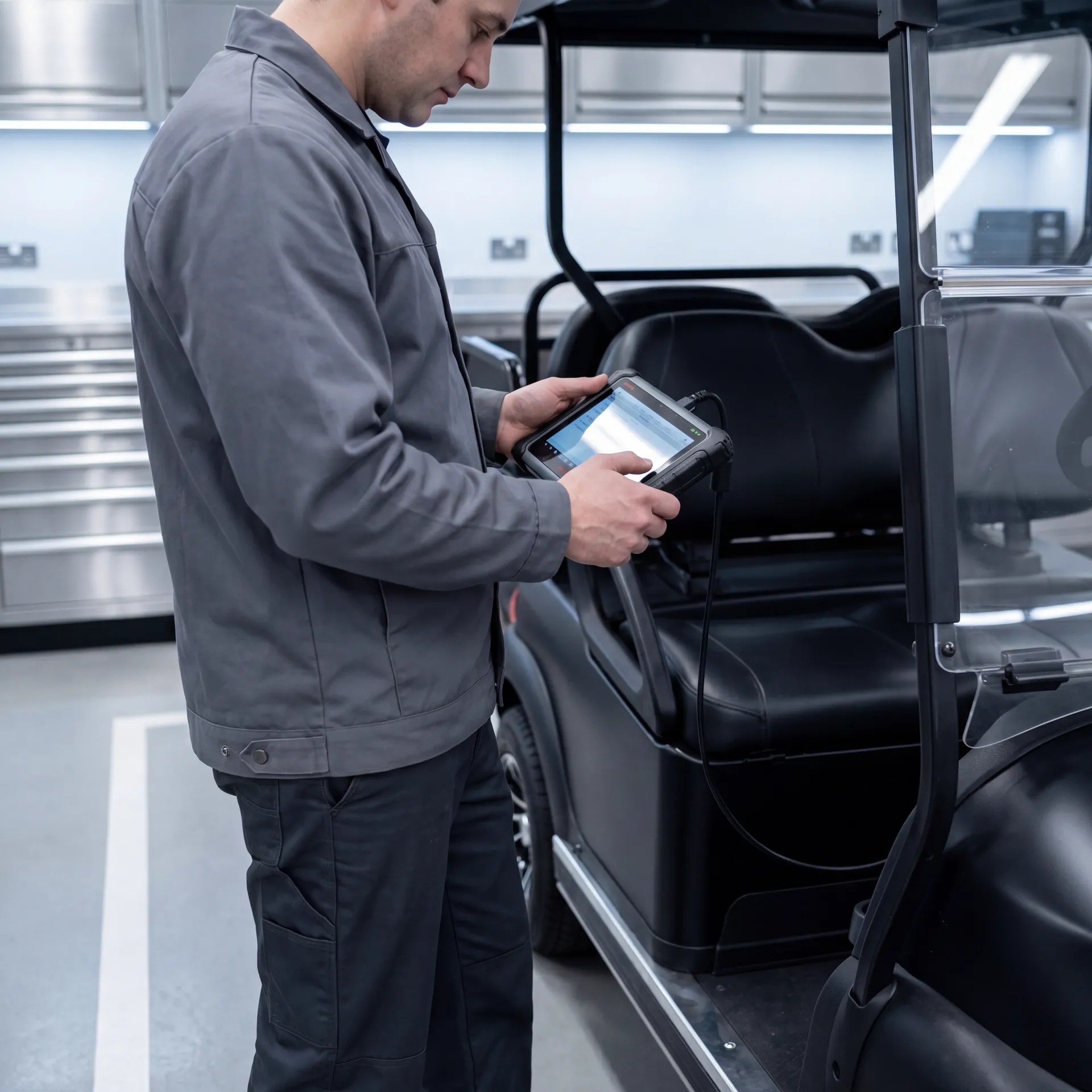
A cart that surges, hunts or delivers power unevenly under a steady foot usually has a fault in the accelerator's sensor or its wiring, the component that tells the controller how much power you are asking for. First rule out the obvious: nothing trapped under the pedal, no mat riding on it, and the pedal returning freely. Beyond that, the throttle sensor and its connections need testing by an engineer, because erratic power on a vehicle that carries people is not a fault to live with.
Dies under load, recovers at rest: the pack
A pack that is low, cold or tired can hold a light load but collapse under a hard one, so the cart stalls on hills or under passengers, then revives after a rest. Charge fully and re-test on the flat: if the problem only appears under load, the pack's health is the prime suspect, and a failing cell shows exactly this way. Our guide to a battery that dies fast covers the triage, and a load test settles it definitively.
Why this one should go to an engineer
Intermittent cut-outs sit firmly on the engineer's side of the line, because the causes, connections, the solenoid, the throttle sensor and the controller, all carry high currents or safety implications, and because an intermittent fault left alone tends to choose its own moment to become permanent. Take the cart out of use, note the pattern and book a visit; it is a short job to fix a connection, and a much longer one to recover a cart that failed on a slope.
Frequently asked questions
Why does my golf cart cut out while driving?+
The most common causes are a loose or corroded connection, controller or motor thermal protection, a faulty pedal sensor, or a pack collapsing under load. When it happens tells you which: bumps point to connections, warmth to protection, hills to the pack.
Why does my cart speed up and slow down on its own?+
Erratic power under a steady foot usually means a faulty throttle sensor or its wiring. Check nothing is trapped under the pedal, then have the sensor tested; surging is not a fault to keep driving with.
Is it safe to keep using a cart that cuts out?+
No. A vehicle that loses power unpredictably is dangerous near slopes, water and people, and the fault will usually worsen. Take it out of use and book an engineer.
My cart slows down when it gets hot. Is that a fault?+
Often it is the controller's thermal protection reducing power deliberately on hard work, which recovers after a few minutes' rest. If it starts happening on work that used to be easy, have it checked.
What should I note down before calling an engineer?+
When it cuts out (acceleration, bumps, hills, when warm), whether it restarts straight away or after a rest, and any beeps or flashing lights. A short phone video with sound is ideal and often lets us diagnose before we arrive.
Cutting out unpredictably?
Take it out of use and let us trace it properly. Book an engineer visit, or a service plan with 24-hour priority call-out for vehicles off the road.
Related solutions
Ready to explore what we build?
See the vehicles and the setting this applies to, or get a tailored quote built around your site.

Ready to find the right golf cart?
Tell us how and where it will work and we will specify a vehicle and a tailored quote built around you. Every build comes with a 3-year warranty and a 24-hour priority call-out.
Our guides are written and reviewed by the Hawke Electric Vehicles team, the people who specify, build, deliver and support the vehicles. We focus on honest, practical advice and flag where a figure depends on the build rather than guessing.
More guides by Hawke