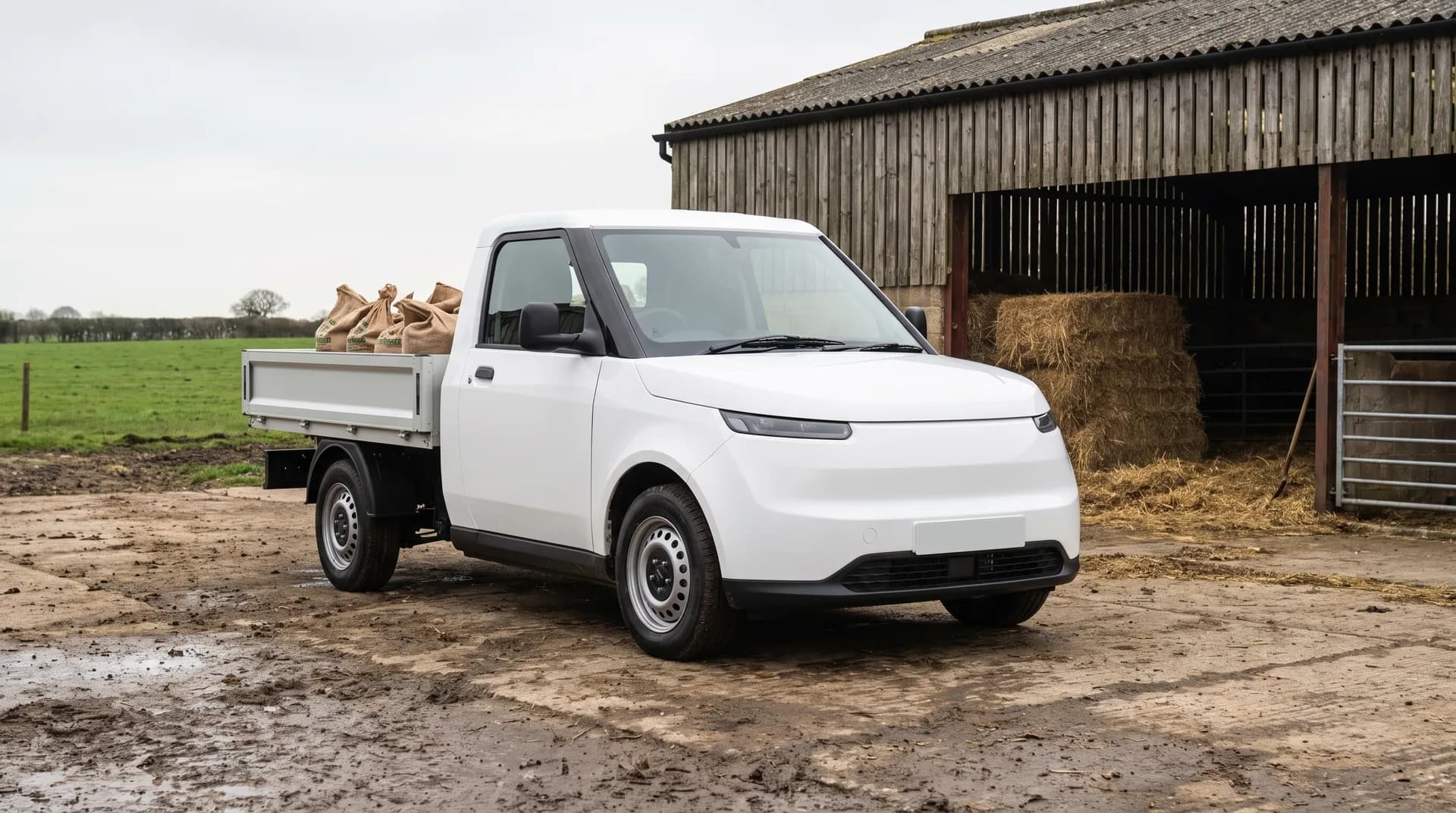
For a smallholding of roughly 5 to 50 acres, a compact electric utility vehicle is usually the right size of machine: big enough to carry feed sacks, fencing kit, water and a passenger, and to pull a small trailer, yet small, cheap and simple enough that it earns its keep on daily rounds a tractor would be wasted on. The smallholder's problem is rarely one heavy job; it is the same half-dozen light jobs every single day, in all weathers. This guide sets out where a compact electric machine fits that pattern, where a quad or a tractor still wins, what winter mud really demands, and how charging works from an ordinary barn supply.
- The daily round, feed, water, fencing, muck, moving stuff, is compact-utility work: typically 300 to 500 kg in the bed plus a small trailer.
- A tractor is overkill for daily rounds and a quad carries almost nothing on its own; the compact UTV is the honest middle.
- A bed you can load flat, drop the sides on and ideally tip beats outright horsepower for smallholding jobs.
- Winter demands tires, ground clearance and sensible routes more than it demands extra power.
- Overnight charging from a standard 13-amp barn socket covers a smallholding's daily mileage with ease.
Why a smallholding suits a compact utility vehicle
Between five and fifty acres, distances are short but constant. Twice-daily feed runs, water in troughs and buckets, hay and straw, tools to the far boundary, muck away, a fallen branch, a sick ewe. None of it needs 50 horsepower; all of it needs a load bed, four wheels and no fuss, several times a day, 365 days a year. That duty cycle is exactly what a compact electric utility vehicle is built for: step in, drive, tip out, plug in at night. There is no cold-start ritual, no gas can to keep filled, and almost nothing to service. Larger holdings running proper field operations are a different conversation, covered in our guide to electric golf carts for farms and agriculture; this one is about the smallholder's daily round.
Where a tractor is overkill and a quad is a compromise
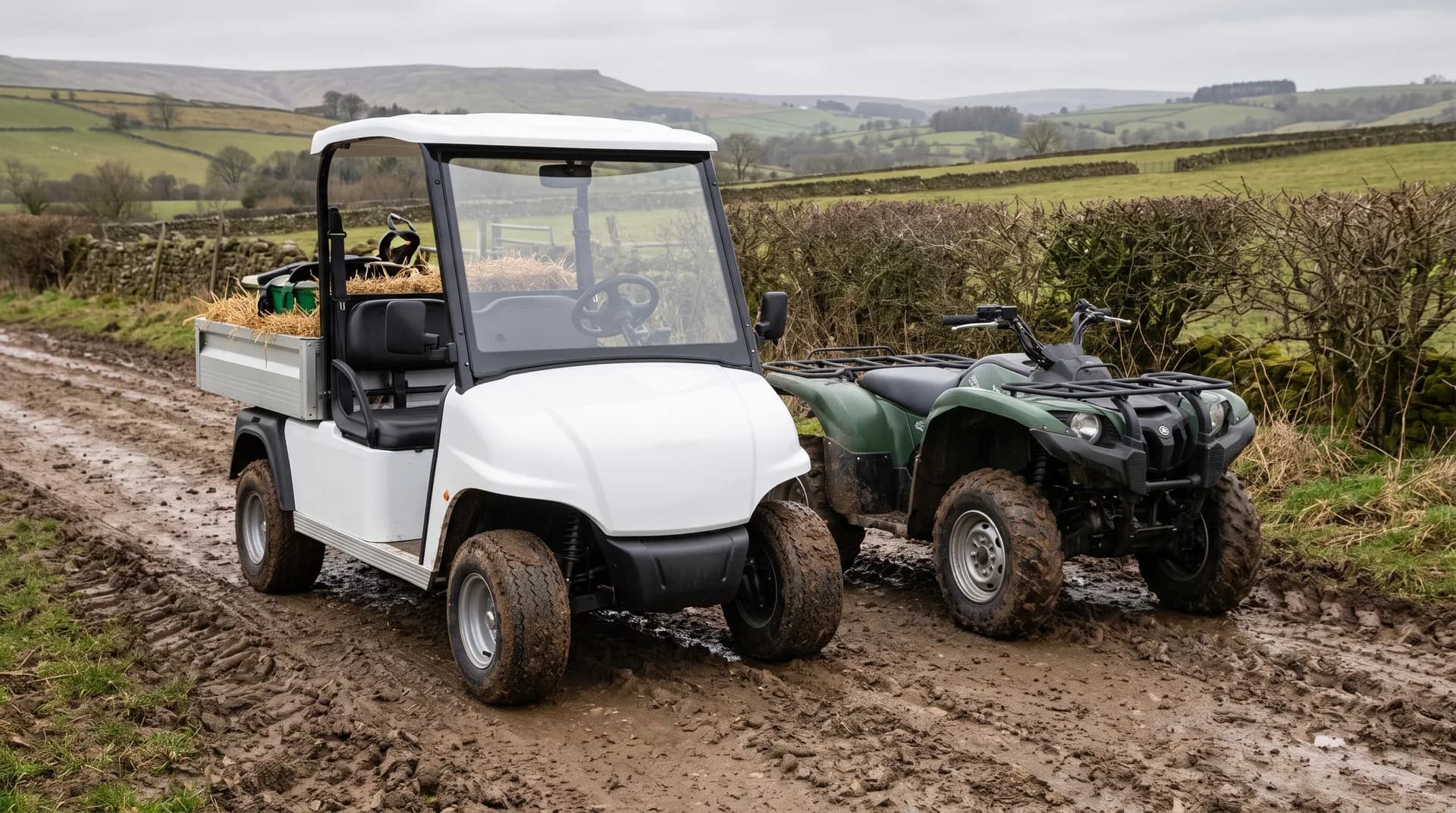
A compact tractor earns its place for ground work: topping, harrowing, front-loader jobs, heavy trailer work. But hitching a tractor for a feed run is like taking a lorry to the postbox. The quad bike is the opposite compromise: quick and go-anywhere, but on its own it carries a rack-load, not a bale-and-bags load, everything must be strapped, and there is no seat for a helper, a child or a dog crate. The comparison in electric utility cart vs quad bike goes through this properly, but the short version is that the compact UTV carries what the quad cannot and costs what the tractor should not: side-by-side seats, a real bed, a hitch, weather protection if you want it. Compact utility machines typically run from the low teens of thousands new, our S2 Pickup starts at £15,900.
The jobs, honestly: feed, fencing, muck, water, trailer
Feed and bedding: a 300 to 500 kg bed takes a day's sacks, small bales and buckets in one trip, flat and unstrapped. Fencing: posts, wire, strainers and a toolbox travel together, and the bed becomes the workbench at the far end. Muck and mucking out: a tipping bed transforms the job, which is why a tipper body or our compact electric tipper is the single most-recommended option for livestock holdings. Water: cans and troughs are heavy, dense loads well inside the rating but far beyond a barrow. Trailer work: a small braked or unbraked trailer behind a compact UTV moves hurdles, a lamb creep or a load of logs around the holding; check the vehicle's stated towing figure and remember drawbar weight counts against payload. That mix, more carrying than any quad, less iron than any tractor, is the smallholding brief in one paragraph.
Winter, mud and the honest limits
A British smallholding January is the real test, so be honest about it. A compact electric UTV on decent all-terrain tires with sensible ground clearance will handle wet grass, poached gateways, rutted tracks and frost without drama, and electric torque helps when pulling away on slick ground. What it is not is a mud plugger: deep standing slop that swallows a wellington will stop a light machine where an agricultural tractor wades through, so plan winter routes along the better ground, keep gateways stoned, and treat the worst corner of the holding as tractor or foot territory in the wettest weeks. Battery range dips in cold weather, but daily smallholding mileage is small, so a machine specified with summer margin still finishes its winter rounds comfortably. Store and charge it under a roof and the cold costs little.
Charging from a barn supply
This is simpler than most buyers expect. A compact utility vehicle charges from an ordinary 13-amp socket, and an overnight charge from a barn or outbuilding supply covers a smallholding's daily use many times over. There is no three-phase requirement and no special charge point to install; what matters is that the socket and its wiring are in good order, ideally on their own circuit with an RCD, and that the vehicle charges under cover. Electricity per mile costs pennies, servicing is minimal because there is no engine oil, filters, plugs or exhaust, and if the holding has solar on a barn roof, daytime top-ups make the running cost smaller still. The wider sums are set out in our electric utility vehicle running costs guide.
Choosing the spec for a smallholding
Specify in this order. Bed first: dropsides and a tipper if you carry muck, feed and loose material. Payload second: 300 to 500 kg covers most holdings; go bigger only if water or building materials feature weekly. Tires third: all-terrain or turf-and-track patterns to suit your ground. Hitch fourth: a pin or ball hitch and a stated towing figure if trailer work is real rather than imagined. Then weather protection to taste, a cab or canopy makes winter rounds civilised, and lithium power for the set-and-forget charging life. The electric utility vehicles range covers these configurations, and a quote against your actual holding beats any brochure comparison.
Frequently asked questions
Is an electric utility vehicle any good on a smallholding?+
For the daily round of feed, water, fencing, muck and general carrying on 5 to 50 acres, it is arguably the best-matched machine: a real load bed and a hitch without tractor money or quad compromises, charging overnight from a barn socket.
Will it cope with mud in winter?+
On proper tires with sensible clearance it handles wet grass, poached gateways and rutted tracks well, helped by electric torque from standstill. Deep standing slop remains tractor territory; plan winter routes along your better ground and keep gateways stoned.
Can it pull a trailer?+
Yes, compact machines typically tow a small site trailer within a stated limit; check the figure for the model and remember drawbar weight counts against payload. For regular heavy trailer work, a tractor or a dedicated tow vehicle is the right tool.
What does charging need?+
An ordinary 13-amp socket in a barn or outbuilding, in good electrical order, with the vehicle charged under cover overnight. No three-phase, no special charge point. Daily smallholding mileage uses only a fraction of a charge.
Quad bike or compact UTV for a smallholding?+
If you mostly travel and rarely carry, the quad is cheaper and faster. If you mostly carry, feed, bedding, tools, muck, water, the UTV wins on the bed, the second seat and the hitch. Most smallholders' weeks are carrying weeks.
Spec a workhorse for your holding
Tell us your acreage, your stock and your worst gateway in January, and we will recommend a configuration and price it honestly.
Related solutions
Ready to explore what we build?
See the vehicles and the setting this applies to, or get a tailored quote built around your site.
Ready to find the right golf cart?
Tell us how and where it will work and we will specify a vehicle and a tailored quote built around you. Every build comes with a 3-year warranty and a 24-hour priority call-out.
Our guides are written and reviewed by the Hawke Electric Vehicles team, the people who specify, build, deliver and support the vehicles. We focus on honest, practical advice and flag where a figure depends on the build rather than guessing.
More guides by Hawke