If your storage space is tight, the right way to buy a golf cart is footprint-first: measure the space, the doorway and the route between them before you fall for any machine, because no feature list survives a garage it cannot enter. The practical answer for most small spaces is a compact two-passenger, typically around 2.3 to 2.5 metres long, about 1.2 metres wide and under 1.9 metres tall, which slots into a single garage, a garden building or a corner of a barn with room to walk past. Our S2, from £11,500, is exactly that footprint and is the machine we point space-limited buyers at first. This guide covers the numbers to check, the door and gate maths that catches people out, and what to do if the space still does not work.
- Measure first, shop second: the space, the aperture and the route in eliminate options faster than any spec sheet.
- The numbers that matter are length, width, height, and the width and height of every door or gate on the way in.
- Allow a real margin: roughly 15 centimetres of clearance each side of the aperture makes daily parking calm instead of surgical.
- A compact two-passenger around 2.4 m by 1.2 m is the small-storage sweet spot; four-seaters and six-seaters need progressively serious space.
- Lithium helps in small spaces: no charging fumes, and charging happens wherever the cart parks, from a standard socket.
Start with the space, not the cart
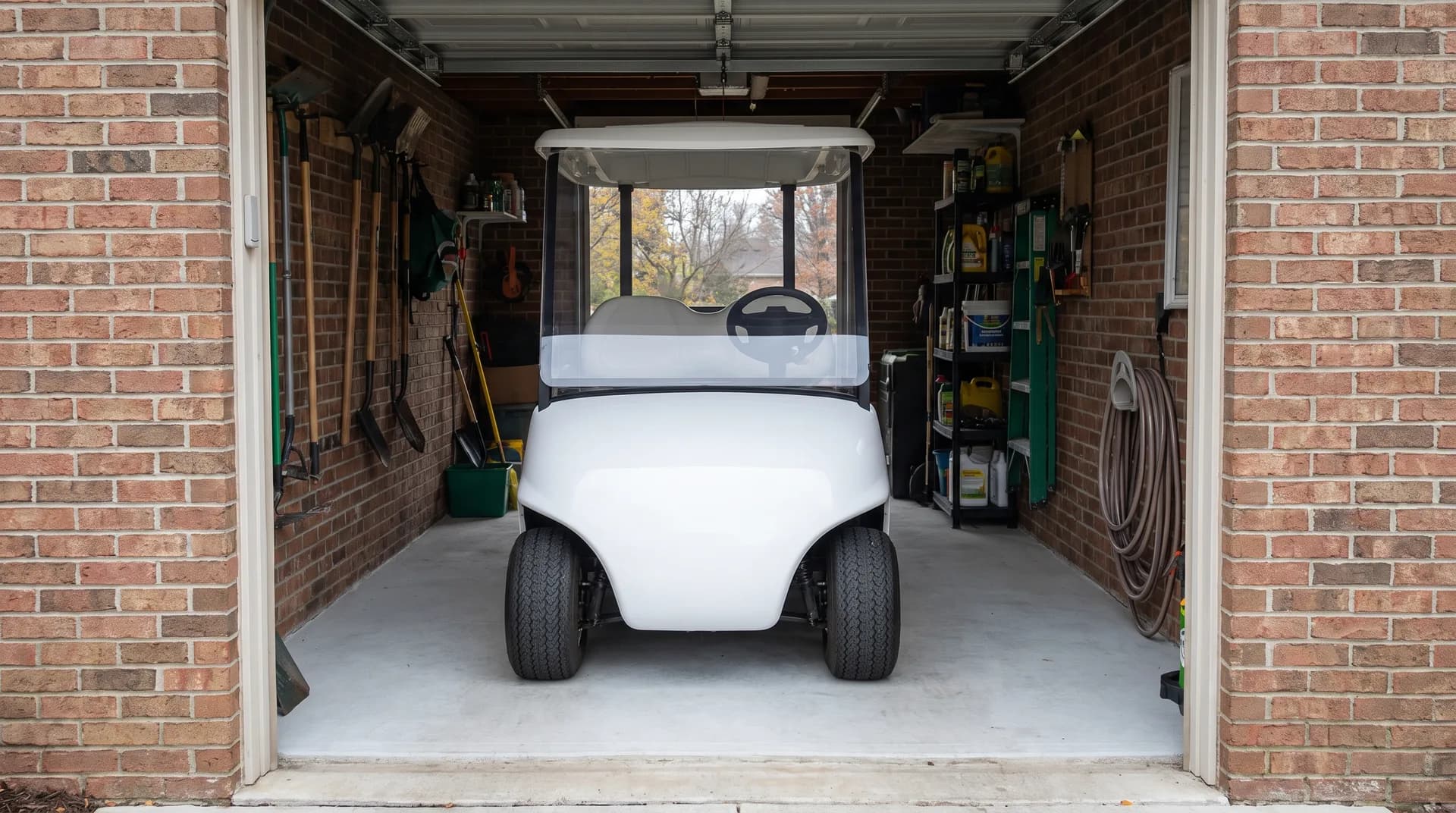
Take a tape measure to the actual space before you open a single brochure. You need three sets of numbers: the internal length, width and height of the space itself, allowing for anything that lives in there with the cart; the width and height of the aperture, meaning the garage door, gate or barn door it must pass through, measured at the narrowest point including frames and hinges; and the route between the road or drive and that aperture, including any tight turn, step or slope. Write them down. Every machine you consider from now on either fits those numbers or it does not, and the discipline of checking saves the genuinely miserable experience of a delivery day discovery.
Compact golf cart dimensions: the numbers that matter
As working figures for planning: a typical two-seat golf cart runs around 2.3 to 2.5 metres long, about 1.2 metres wide and 1.7 to 1.9 metres tall with the canopy up. Four-seaters stretch to roughly 2.9 to 3.4 metres long, and six-seaters to around 3.6 metres and beyond, at similar widths and heights. Height matters more than people expect, because the canopy is the tallest point and some garage doors, particularly up-and-over designs, reduce effective height as they open. Exact figures vary by model and specification, so use our golf cart dimensions guide for the detailed tables and always confirm the numbers for the specific machine you are quoted before ordering.
- Typical 2-passenger
- 2.3 to 2.5 m
- Typical 4-passenger
- 2.9 to 3.4 m
- Typical 6-passenger
- 3.6 m and up
- Typical 2-passenger
- About 1.2 m
- Typical 4-passenger
- 1.2 to 1.4 m
- Typical 6-passenger
- 1.2 to 1.5 m
- Typical 2-passenger
- 1.7 to 1.9 m
- Typical 4-passenger
- 1.8 to 2.0 m
- Typical 6-passenger
- 1.8 to 2.0 m
- Typical 2-passenger
- Fits with room to spare
- Typical 4-passenger
- Tight, often car-length limited
- Typical 6-passenger
- Realistically no
| Typical 2-passenger | Typical 4-passenger | Typical 6-passenger | |
|---|---|---|---|
| Length | 2.3 to 2.5 m | 2.9 to 3.4 m | 3.6 m and up |
| Width | About 1.2 m | 1.2 to 1.4 m | 1.2 to 1.5 m |
| Height (canopy up) | 1.7 to 1.9 m | 1.8 to 2.0 m | 1.8 to 2.0 m |
| Single garage | Fits with room to spare | Tight, often car-length limited | Realistically no |
The door and gate maths
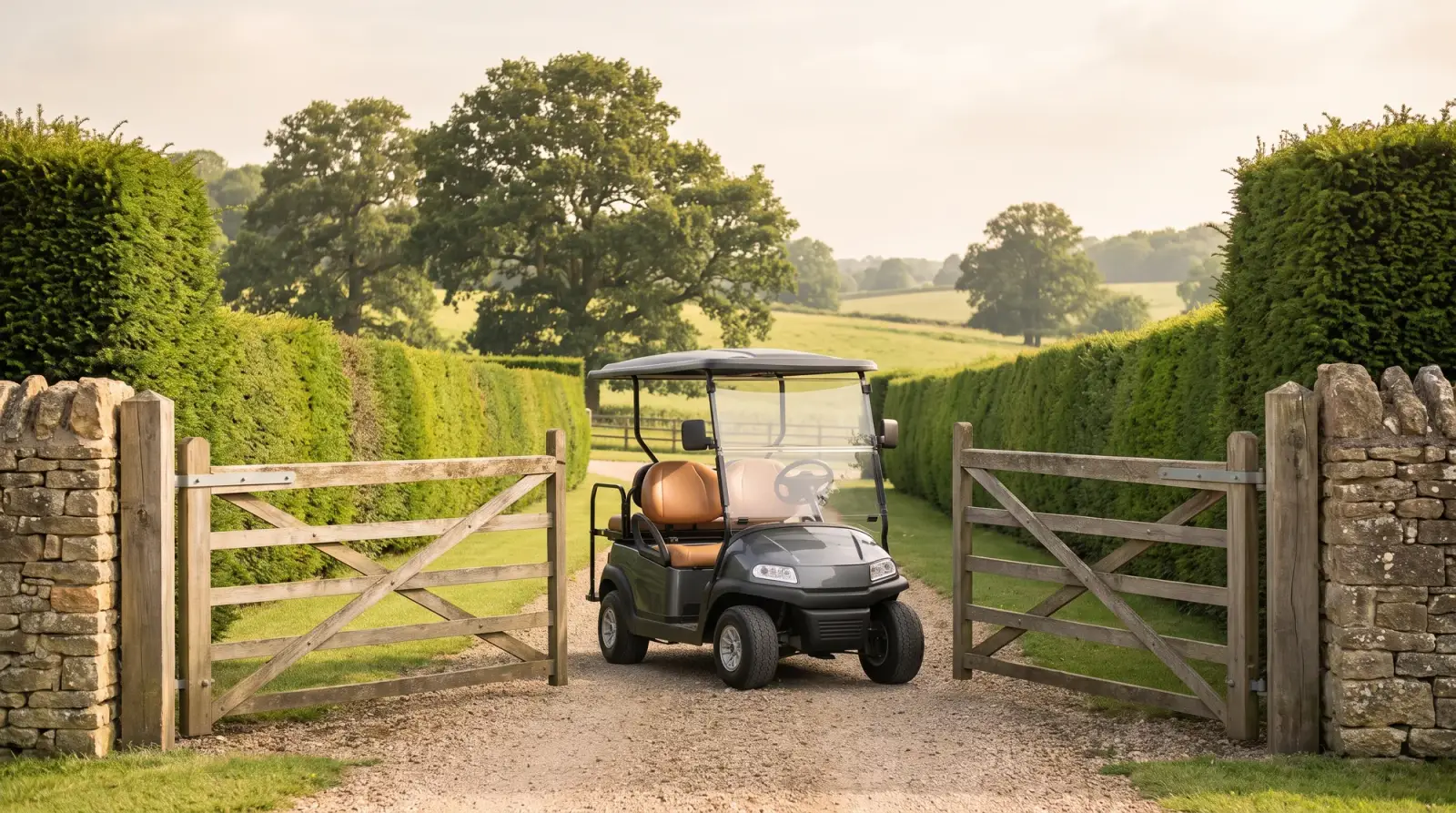
The aperture is where small-space plans fail, so do the arithmetic honestly. Take your measured aperture width and subtract the cart's width: if the answer is less than about 30 centimetres, meaning roughly 15 centimetres of clearance each side, daily parking will be a precision exercise, and anything under 15 centimetres total is a scrape waiting for a tired evening. Check height against the aperture's lowest point, not the wall height, since door mechanisms and frames steal centimetres. Then walk the approach: a cart needs a few metres of reasonably straight run to line up on a narrow opening, so a gate at right angles to a narrow passage can defeat a machine that would fit the gate head-on. Steps need a ramp, and a steep ramp straight into a doorway needs headroom checked at the top of the slope, where the canopy is momentarily higher relative to the frame.
The best golf cart for small storage spaces: the compact pick
Within those constraints, the recommendation is straightforward: a modern compact two-passenger. Our S2, from £11,500, carries two golfers and their bags in a footprint of roughly a small car's width and half its length, turns tightly enough to manage narrow approaches, and gives up nothing in comfort or capability to larger machines beyond the second row of seats. If you are weighing it against other two-seat options, our guide to the best two-passenger golf carts makes the comparison, and the full range shows what each model needs in space terms. Resist the temptation to squeeze in a four-passenger you will rarely fill: the second row costs you the walking-past room and the easy parking that make a small space liveable, and it is usually the wrong trade.
Charging and living with a cart in a small garage
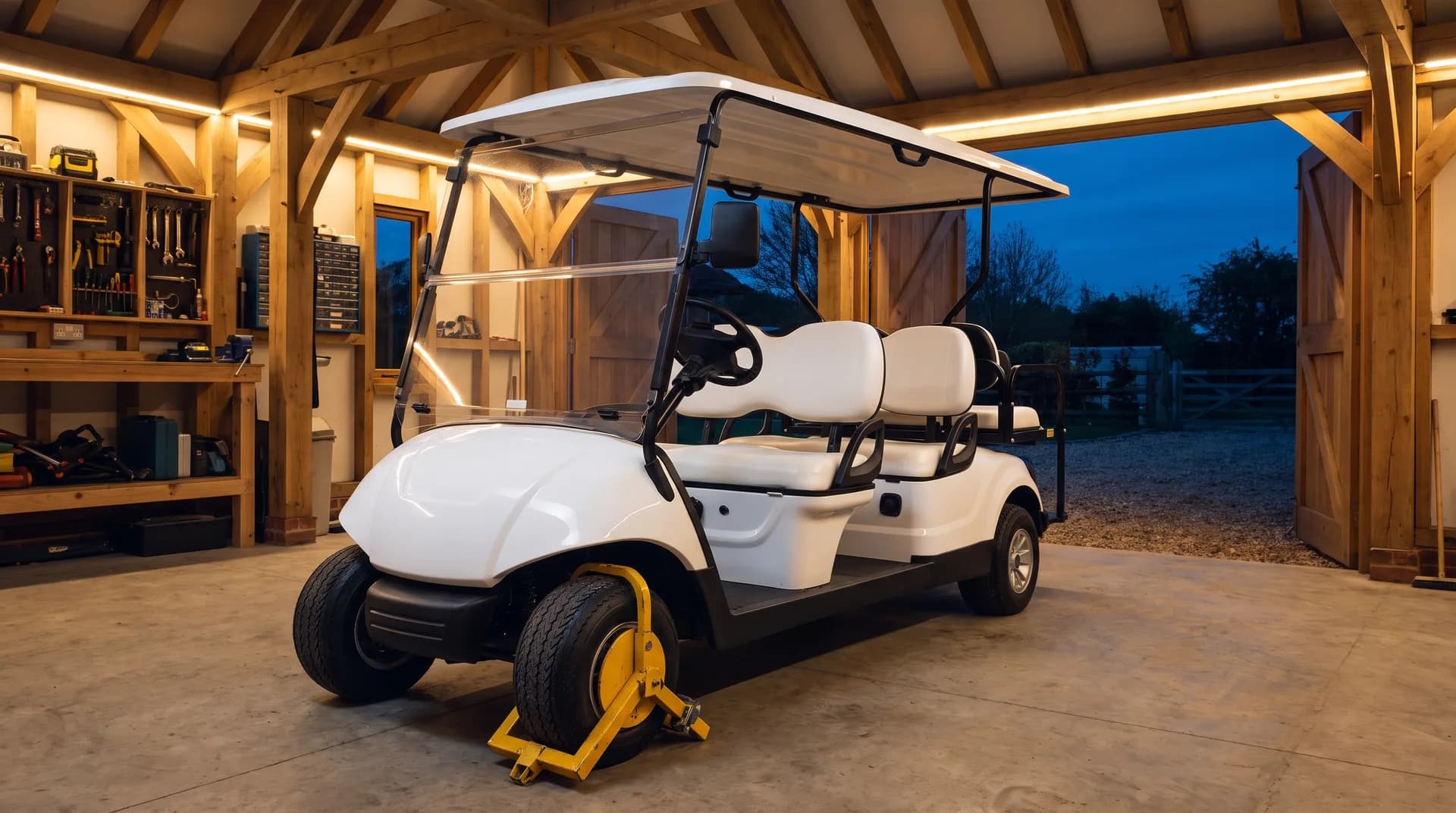
A small space works best with a lithium cart. Charging happens wherever the machine parks, from a standard household socket on an overnight charge, with no need to move it to a charging area, and lithium packs do not produce the gassing that made ventilation a genuine consideration when charging older lead-acid batteries indoors. Keep the charger mounted on the wall rather than trailing on the floor, leave the socket reachable without squeezing past the machine, and think about security while you are at it: a small dedicated space is easy to lock and easy to alarm, which insurers like. Our storage and security guide covers locks, trackers and storage conditions in detail. And if every measurement in this guide has come out against you, the fallback options are honourable: cart storage at your club, or hiring when you play, both of which cost less than widening a garage.
Frequently asked questions
Will a golf cart fit in a single garage?+
A compact two-passenger will, comfortably: typical dimensions of around 2.4 m long by 1.2 m wide leave walking-past room in a standard single garage. A four-passenger is tight and a six-passenger realistically will not fit. Measure your aperture as well as the internal space before committing.
How wide is the narrowest golf cart?+
Compact two-seaters are the narrowest full golf carts, at around 1.2 metres. If your limiting gap is much under 1.4 metres you should measure carefully and confirm the exact specification of any machine before ordering, since trims and mirrors add centimetres.
How much clearance do I need through a gate or door?+
Aim for roughly 15 centimetres each side for calm daily use. Less is possible but turns every entry into a precision job, and under about 15 centimetres in total is asking for scraped bodywork. Height should clear the lowest point of the open door, not the ceiling.
Can I charge a cart in a small enclosed garage?+
Yes. A lithium cart charges from a standard socket where it parks and does not gas during charging the way old lead-acid packs could. Keep the charger wall-mounted, the cable off the floor and the socket accessible without climbing past the machine.
What if my space is just too small?+
Store the cart at your golf club if it offers cart shed space, or hire when you play instead of owning. Both are better answers than forcing a machine into a space that makes every arrival and departure a battle.
Check a cart against your space
Send us your measurements, the space, the doorway and the route in, and we will tell you honestly which models fit and quote the right one to your specification.
Related solutions
Ready to explore what we build?
See the vehicles and the setting this applies to, or get a tailored quote built around your site.
Ready to find the right golf cart?
Tell us how and where it will work and we will specify a vehicle and a tailored quote built around you. Every build comes with a 3-year warranty and a 24-hour priority call-out.
Our guides are written and reviewed by the Hawke Electric Vehicles team, the people who specify, build, deliver and support the vehicles. We focus on honest, practical advice and flag where a figure depends on the build rather than guessing.
More guides by Hawke