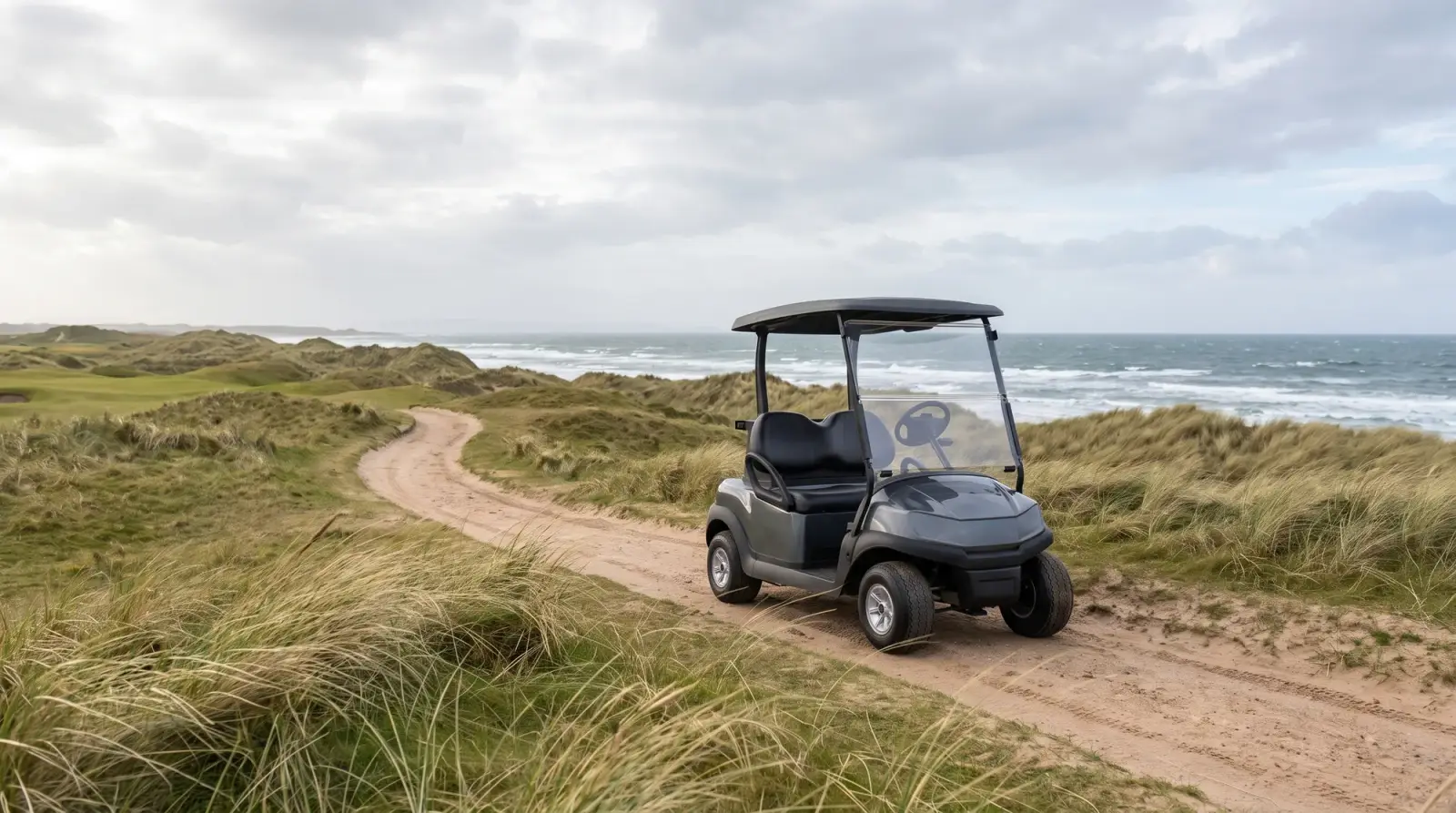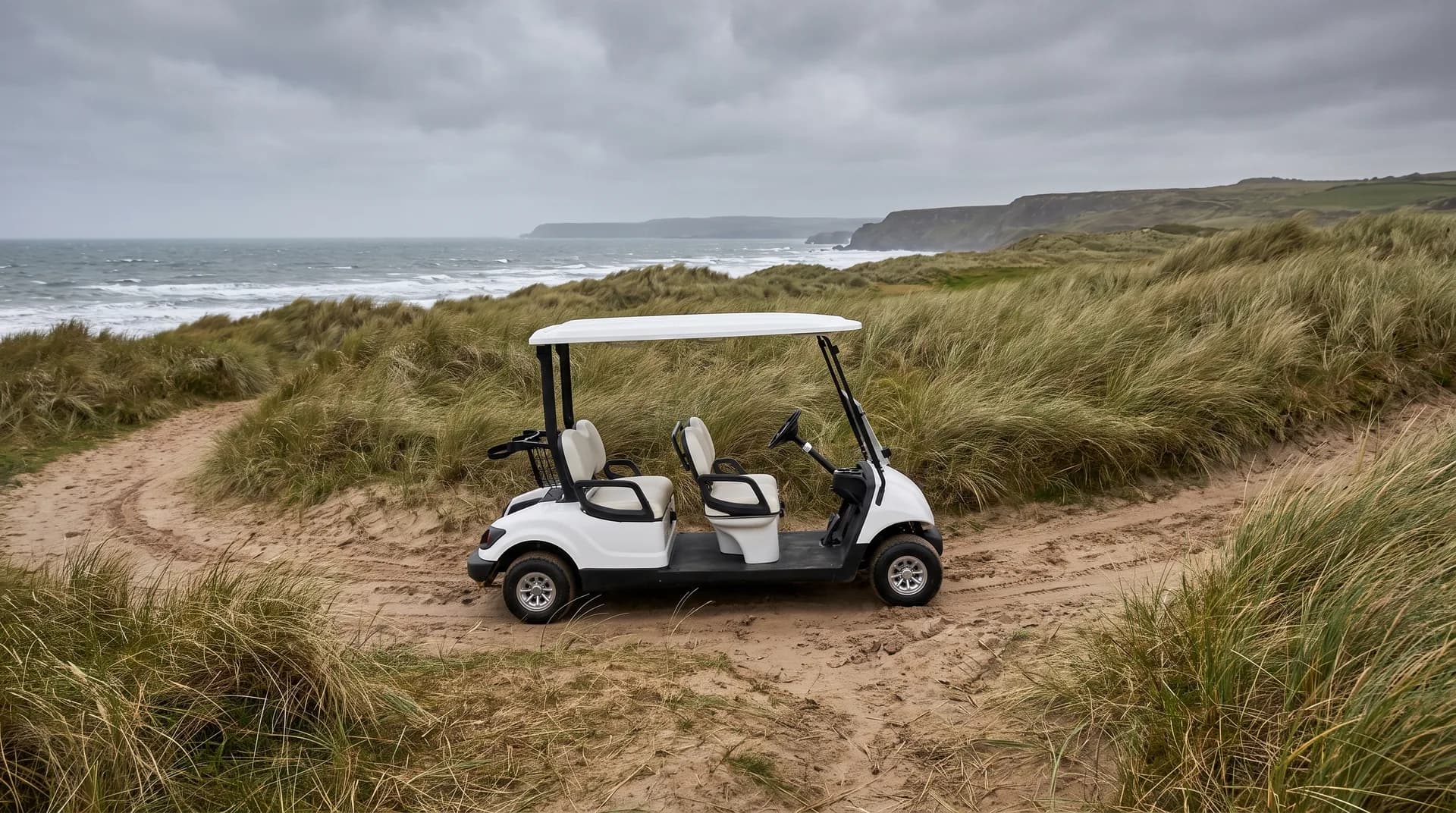
A links course is the hardest place in British golf to be a cart. The ground heaves through dunes and hollows, the wind never really stops, there is no tree line to hide behind when the weather arrives, and the air itself carries salt that works on every terminal and fastener. The best golf cart for a links course is therefore a specific machine: four wheels on a wide track, lithium power with real reserve for climbing out of hollows into a headwind, turf tires that grip wet, sandy paths without carving them up, weather protection you can actually shelter behind, and an owner committed to rinsing the salt off. This guide covers the spec and the care. If you first need to know which courses permit golf carts at all, our list of UK links courses that allow golf carts answers that; this guide is about choosing the machine itself.
- Wind and dunes punish marginal machines: specify a wide-track four-wheeler with power and battery reserve to spare.
- Lithium suits links golf: headwinds and climbing drain batteries faster than flat parkland ever does.
- Salt air is relentless. A freshwater rinse after coastal rounds and dry storage do more for lifespan than any accessory.
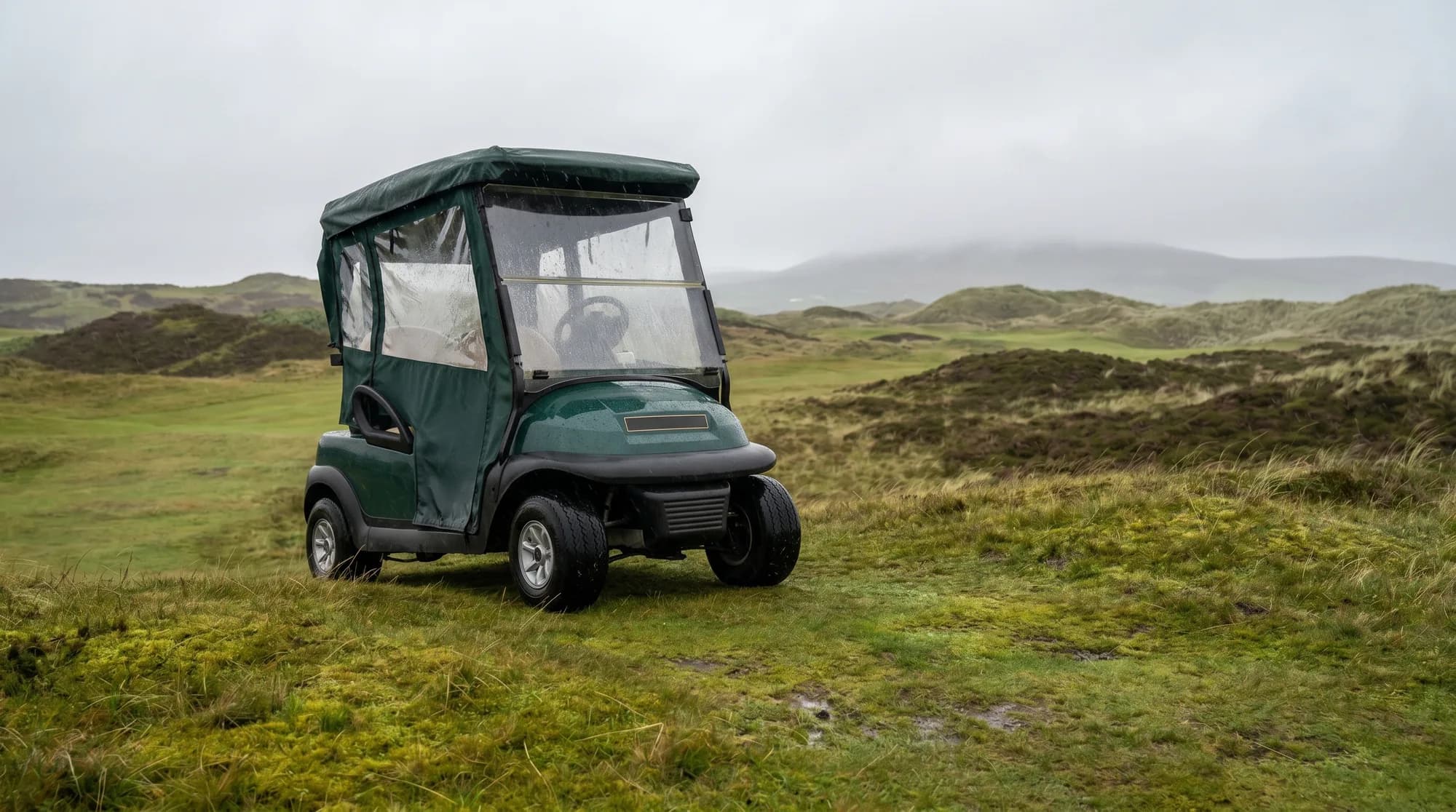
- Weather protection is not a luxury on a links: roof, screen and side protection keep the machine usable most of the year.
- Check the club's cart policy before buying: links clubs are often the strictest about where and when golf carts go out.
What a links course asks of a cart
Parkland golf is mostly flat, sheltered and forgiving of an underpowered machine. Links golf is none of those things. The routing runs through dunes, so a cart is constantly climbing short, sharp banks, often on sandy paths with loose surfaces. There is little shelter, so the machine drives into wind for holes at a time, and wind resistance is real work for a motor pushing a canopy along. Rain arrives sideways. And because links turf is prized and drains onto sand, clubs are particular about where wheels go, which puts a premium on tires and driver discipline. A cart that feels adequate inland can feel breathless and exposed by the turn on a proper links.
The best golf cart for links courses: the spec that copes
Start with the chassis. Four wheels on a wide track, never three, because dune-side cambers and wet slopes demand a planted machine, and a low center of gravity keeps it that way. Then power and energy: a motor with torque in reserve for short climbs, and a lithium battery sized so a windy winter round finishes with plenty left, because headwinds and repeated climbing can take a meaningful bite out of range compared with a still day on the flat. Lithium also holds its performance in cold weather better than tired lead-acid, which is worth having in a February sea breeze. Turf tires with a gentle tread protect the surfaces the club cares about while still gripping wet grass; if your links is properly hilly, the braking and tire advice in our hills and wet weather guide applies in full. Our S2, from £11,500, and the four-seat S4, from £14,900, both fit this brief, and you can compare the whole electric golf cart range against it.
- Typical parkland
- Mostly flat, firm paths
- Typical links
- Dunes, hollows, sandy and loose paths
- Typical parkland
- Sheltered by trees
- Typical links
- Constant, with real drag on the machine
- Typical parkland
- Steady and predictable
- Typical links
- Higher: climbs and headwinds eat range
- Typical parkland
- Showers, some shelter
- Typical links
- Sideways rain, no hiding places
- Typical parkland
- Low
- Typical links
- Salt air on every metal part, year round
- Typical parkland
- Usually relaxed
- Typical links
- Often strict on routes, weather and permissions
| Typical parkland | Typical links | |
|---|---|---|
| Terrain | Mostly flat, firm paths | Dunes, hollows, sandy and loose paths |
| Wind | Sheltered by trees | Constant, with real drag on the machine |
| Battery draw | Steady and predictable | Higher: climbs and headwinds eat range |
| Weather exposure | Showers, some shelter | Sideways rain, no hiding places |
| Corrosion risk | Low | Salt air on every metal part, year round |
| Club rules | Usually relaxed | Often strict on routes, weather and permissions |
Weather protection: staying out in it
On a links, weather protection decides how much golf the cart actually enables. A roof and a windscreen are the minimum; side protection, whether fitted panels or a full enclosure, turns a machine you use from May to September into one you use most of the year. Look also at where water goes: seats and floors that drain and wipe dry beat absorbent trim, and a screen you can see through in rain matters more than one that looks sleek in the sun. Electric golf carts are built to be rained on, the running gear is sealed against British weather as standard, so the question is whether passengers stay comfortable, not whether the machine survives.
Salt air and the links course cart: a care routine
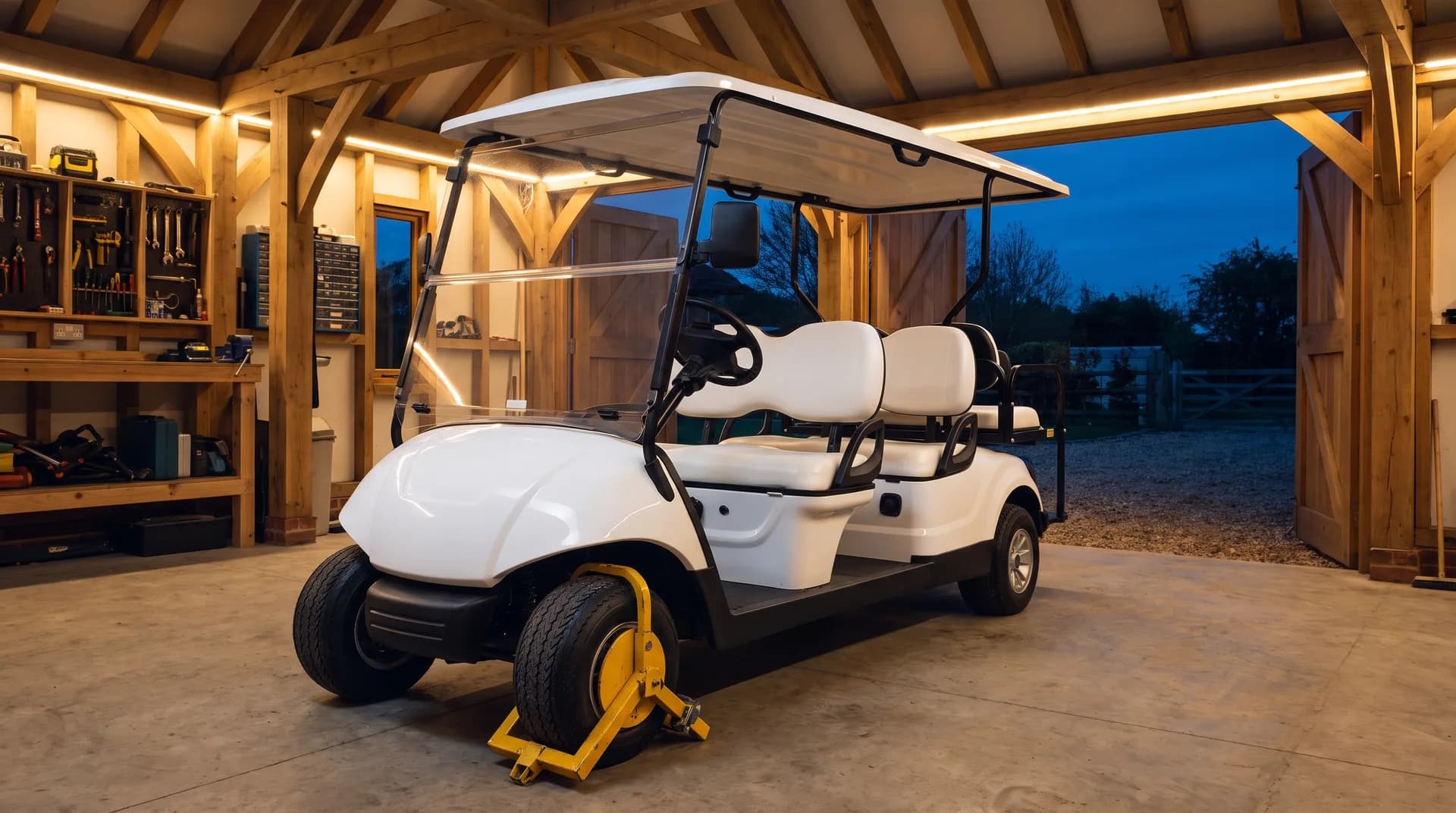
Salt is the tax every coastal machine pays, and the owners who pay least are the ones with a routine. Rinse the cart with fresh water after rounds in sea spray or blown sand, paying attention to the underside, fasteners and anything unpainted, then let it dry before it goes away. Keep battery terminals and electrical connections clean and protected, and have corrosion checked at every service rather than waiting for something to seize. Store the machine indoors and dry, not under a tarpaulin that traps damp sea air against the bodywork; our guide to storage and security covers the options. None of this is onerous, ten minutes with a hose, but done consistently it is the difference between a cart that ages like an inland one and one that looks tired in three seasons.
Club permission on links courses
Links clubs guard their turf, reasonably, and many of the famous ones restrict golf carts more tightly than inland clubs: medical-certificate policies, designated routes, seasonal and weather-based suspensions, and limited cart shed space with real waiting lists. Before you order a machine for links golf, have the conversation with the club: whether private golf carts are permitted at all, where it would live, and what the winter policy is. Our guide to taking your own cart to the golf club sets out the questions to ask, and the list of links courses that allow golf carts linked above tells you where the conversation is likely to go well. A cart specification is easy to get right; a permission you assumed and did not have is not.
Frequently asked questions
Do links courses allow golf carts?+
Many do, but policies vary more than anywhere else in British golf. Some links welcome golf carts on designated routes, some restrict them to golfers with medical certificates, and some suspend them in winter or wild weather. Always confirm with the club before buying a machine for links golf.
Does salt air damage electric golf carts?+
Left unmanaged, salt accelerates corrosion on fasteners, terminals and unpainted metal. Managed with a freshwater rinse after salty rounds, dry indoor storage and corrosion checks at service time, a coastal cart can age much like an inland one.
Is lithium worth it for a links course?+
Usually, yes. Headwinds and repeated dune climbs increase energy use, and lithium offers more usable capacity, better cold-weather behaviour and less weight than lead-acid. On an exposed course the extra reserve is comfort you will use.
Will wind actually affect a cart?+
Driving into a steady coastal wind adds measurable load, which shows up as range used rather than any handling drama. A well-specified machine simply consumes more battery on windy days, which is why reserve capacity matters on a links.
What tires are best for links turf?+
Gentle-tread turf tires are the standard answer: enough grip for wet grass and sandy paths without tearing the surfaces clubs protect. Aggressive off-road treads are the wrong choice on a course and are the kind of thing that gets private golf carts banned.
Specify a cart for coastal golf
Tell us your course and how you play it, and we will specify a machine with the stability, reserve and weather protection links golf demands, then price it for you.
Related solutions
Ready to explore what we build?
See the vehicles and the setting this applies to, or get a tailored quote built around your site.
Ready to find the right golf cart?
Tell us how and where it will work and we will specify a vehicle and a tailored quote built around you. Every build comes with a 3-year warranty and a 24-hour priority call-out.
Our guides are written and reviewed by the Hawke Electric Vehicles team, the people who specify, build, deliver and support the vehicles. We focus on honest, practical advice and flag where a figure depends on the build rather than guessing.
More guides by Hawke