Golf buggy won't start: causes and fixes
Written by the Hawke Electric Vehicles Service Team
Quick answer
A golf buggy that is completely dead on the key and pedal is nearly always losing power before it reaches the controls: a flat or disconnected pack, a Tow/Run switch left in Tow, a blown main fuse or a failed key switch, roughly in that order. Start with a rested voltage reading across the whole pack, then confirm the Tow/Run switch is in Run before you touch anything else.
Tools needed
- Digital multimeter
- Safety glasses
- Insulated gloves
- Work light
Parts needed
- Replacement main fuse, rating as printed on the holder
Confirm the symptom
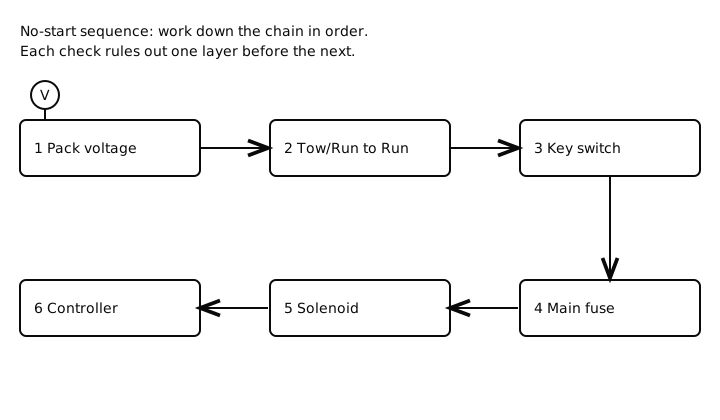
This is the master guide for a golf buggy that does nothing you can detect when you switch on and press the pedal: no dash lights, no reading on the battery meter, no click from under the seat and no movement. It walks the no-start chain in the order an engineer would follow, so each check rules out one layer of the system before you move to the next. Working in order matters, because a flat pack and a failed controller look identical from the driver's seat, and only the sequence tells them apart.
A few quick checks tell you whether you are on the right guide. If the dash lights and battery meter come on but the buggy will not drive, the power is getting through and you want Powers on but won't move instead. If pressing the pedal produces a single click from under the seat but no motion, go to Solenoid clicks but no movement. If there is no click at all even though the lights are on, go to No click when pressing the pedal. And if the real problem is that the buggy will not charge, see Golf buggy not charging, because a pack that never charged will always fail to start.
1Switch on and watch the dash
Turn the key or press the run button and look at the dash lights and the battery meter.
ExpectedNothing at all points at the supply side: pack, main connections, Tow/Run switch, main fuse or key switch. Lights that come on move the fault further down the chain, towards the solenoid and controller.
2Press the pedal and listen under the seat
With the Tow/Run switch in Run, press the accelerator and listen for a click from the solenoid under the seat.
ExpectedA distinct click means the coil circuit is working and you can concentrate on the contacts, controller and motor. No click keeps the focus on the coil circuit, key switch and fuse.
What causes it
| Cause | How common | How to confirm | Fix |
|---|---|---|---|
| Flat pack or an open main connection | very common | Measure rested pack voltage at the terminals and check the main cables | How to test golf buggy batteries with a multimeter |
| Tow/Run switch left in the Tow position | very common | Set the switch to Run, wait ten seconds and try again | |
| Blown main fuse or tripped breaker | common | Locate the main fuse and continuity-test it | |
| Failed key switch or loose spade terminals | common | Back-probe the key switch output with the key on | |
| Solenoid not closing or contacts burned | common | Listen for a click, then voltage-test across the large terminals | Golf buggy solenoid test and replacement |
| Controller or its throttle input | occasional | Rule out everything above, then read controller status where fitted | How to reset a golf buggy: step-by-step reset guide |
A flat or disconnected battery pack
The most common reason a buggy is completely dead is the simplest one: the pack has no usable charge, or the current cannot leave it. A pack left for weeks self-discharges, and a single failed battery can pull the whole set below the voltage the controls need to wake up. Loose or corroded main terminals do the same thing by breaking the circuit before it ever reaches the controller.
3Measure rested pack voltage at the terminals
With the charger unplugged and the buggy switched off, set a multimeter to DC volts and read across the whole pack, from the most positive terminal to the most negative.
ExpectedA healthy rested 36 V pack reads about 38.2 V and a 48 V pack about 50.9 V. Around 36.5 V on a 36 V pack, or 48.7 V on a 48 V pack, is roughly half charge. A reading far below that, or close to zero, means the pack is flat or the circuit is broken.
4Check the main cables and terminals
Inspect the main positive and negative cables and every battery interconnect for looseness, green or white corrosion, or heat damage, and nip up any terminal that moves.
ExpectedFull pack voltage at the batteries but nothing reaching the controller points at a broken main connection. A terminal that is loose, corroded or warm is the likely break.
If the pack is simply flat, charge it fully and test again. The guide on testing batteries with a multimeter covers reading each battery to find one that is dragging the set down, and the corroded terminals guide covers cleaning and protecting the posts. If one battery will not hold voltage after a full charge, it has failed and the pack will keep letting you down until it is replaced.
The Tow/Run switch left in Tow
Many buggies have a Tow/Run switch under the seat that disconnects the controller so the vehicle can be towed or worked on safely. In the Tow position the buggy is dead by design: no drive, and on some models no lights either. It is the first thing to rule out because it costs nothing and catches a surprising number of no-starts, especially after the buggy has been moved or serviced.
5Set the switch to Run and try again
Find the Tow/Run switch, set it firmly to Run, wait about ten seconds and try the pedal again.
ExpectedIf the buggy wakes up, the switch was the whole problem. If it stays dead in Run, move on, but note that the switch itself can fail; on Club Car models with an onboard computer, leaving it in Tow also blocks charging.
If the switch feels vague, or the buggy only works when it is wiggled, the switch or its wiring is worn and wants replacing; that is covered in the Tow/Run switch guide.
A blown main fuse
Most buggies carry a main fuse or circuit breaker protecting the controls, and some have a separate accessory fuse. A blown main fuse cuts everything downstream, so the symptoms look exactly like a flat pack even though the batteries are fine. Fuses rarely blow for no reason, so treat a blown fuse as a symptom and look for what caused it before fitting a replacement.
6Locate and continuity-test the main fuse
With the pack isolated at the Tow/Run switch, find the main fuse, remove it and test it on the multimeter's continuity or resistance range.
ExpectedA good fuse beeps on continuity or reads near 0 ohms. An open reading means it has blown and needs replacing with the same rating; the guide on locating and testing fuses maps where they live by brand.
Fit only the rating printed on the holder. If a new fuse blows straight away, something downstream is drawing too much current, and fitting a larger fuse only hides a fault that can overheat wiring.
A failed key switch
The key switch feeds the low-current control circuit that tells the rest of the system to wake up. When it fails, the buggy is dead even though the pack, fuse and Tow/Run switch are all fine. Worn switches and loose spade terminals on the back of the switch are the usual culprits, and an intermittent switch that works only when the key is jiggled is a classic sign.
7Check for output from the key switch
Set the meter to DC volts, back-probe the key switch output terminal against pack negative, and turn the key on.
ExpectedBattery voltage on the input but nothing on the output with the key on means the switch or its connections have failed. Voltage passing through confirms the switch is doing its job and the fault is further down.
Loose spade terminals often only need cleaning and pushing home; a worn switch wants replacing, as covered in the key switch guide.
The solenoid not closing
The solenoid is the heavy relay that connects the pack to the controller and motor circuit when you press the pedal. It has two small terminals for the coil and two large terminals for the main current. If the coil is not energised it will not click, and if the contacts are burned it clicks but passes no current. Either way the buggy will not move.
8Listen for the click and voltage-test the large terminals
Press the pedal and listen for a click; if it clicks, set the meter across the two large terminals while a helper holds the pedal down.
ExpectedA good solenoid clicks and, with the contacts closed under load, drops close to 0 V across the large terminals. Full pack voltage across closed contacts means they are burned and not passing current.
No click at all points back up the coil circuit to the key switch, throttle input and Tow/Run switch, which is the No click when pressing the pedal path. A click with no drive is the Solenoid clicks but no movement path. The full coil and contact test, and how to replace the unit safely, are in Testing and replacing a solenoid.
The controller or its throttle input
The controller sits last in the chain, not because controllers are unreliable but because everything ahead of it is more likely and quicker to check. Before suspecting the controller, rule out the throttle input that feeds it: on Club Car models with an MCOR throttle sensor, or E-Z-GO models with an inductive throttle sensor, a failed sensor stops the controller ever asking for drive. A no-start that survives every check above, with a healthy pack, a closing solenoid and a working key switch, is where the controller and its input come into focus.
9Read the controller status where fitted
On buggies with a controller status light or diagnostic display, note any blink code or fault reading with the key on and the pedal pressed.
ExpectedA steady healthy indication with no drive points at the throttle input or the controller output stage; a fault code names the area to investigate. Many controllers also respond to a reset, covered in the reset procedures guide.
Controllers store dangerous voltage on their internal capacitors, and their diagnosis needs care, so if the chain ends here without a clear answer, this is the point to bring in an engineer rather than replacing parts on a guess.
When to book an engineer
Book an engineer if the pack tests healthy but the buggy stays dead through the whole chain, if a replacement main fuse blows immediately, if the solenoid contacts are burned, or if the fault points at the controller or its throttle input. These are routine diagnoses with the right meter and a little time, and working through them in order is far cheaper than replacing a controller, then a solenoid, then a pack in the hope that one of them was the answer.
Common questions
What should my pack read if the buggy will not start?
A rested 36 V pack should read about 38.2 V and a 48 V pack about 50.9 V. Roughly 36.5 V or 48.7 V is about half charge and should still start the buggy. A reading well below that, or near zero, means the pack is flat or a main connection is broken, and that is the place to start.
Why is my buggy completely dead with no lights at all?
Total silence points at the supply side: a flat or disconnected pack, a Tow/Run switch left in Tow, a blown main fuse or a failed key switch. Work through them in that order, because each is quicker to check than the one after it, and any of them will kill everything downstream.
Where is the Tow/Run switch and why does it stop the buggy?
It is usually under the seat near the batteries or the controller. In Tow it disconnects the controller so the buggy can be moved or worked on without driving itself, which also means it is dead until you set it back to Run. Always check it first after the buggy has been towed or serviced.
Can one bad battery stop the whole buggy starting?
Yes. Batteries are wired in series, so one failed battery drops the whole pack voltage and can pull it below the level the controls need to wake up. Reading each battery individually with a multimeter finds the weak one; the battery testing guide shows the rested voltages to expect.
Is it safe to test the buggy myself?
Meter checks are safe if you set the Tow/Run switch to Tow for anything beyond probing, remove metal jewellery and keep tools from bridging the terminals. The pack can deliver enough current to weld metal and cause burns, and the controller holds a charge after isolation, so leave controller internals to an engineer.
Do I need to reset anything after fixing a no-start?
Sometimes. On Club Car models with an onboard computer, a Tow/Run and pack-disconnect reset can be needed to clear a latched state, and some controllers want a key cycle. The reset procedures guide lists the sequence by brand.
Did this fix it?
Every guide is written from manufacturer service documentation and workshop practice, then reviewed before publication. Read how we write and review our repair guides.