Golf buggy solenoid clicks but won't move
Written by the Hawke Electric Vehicles Service Team
Quick answer
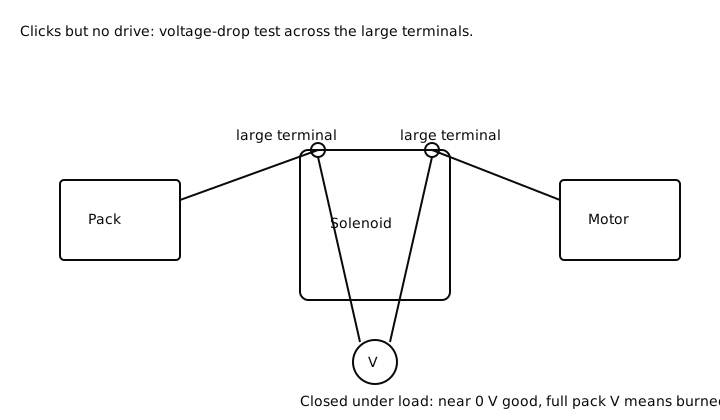
A solenoid that clicks when you press the pedal but gives no drive has a working coil, so the fault is that current is not crossing the main contacts. Burned or pitted contacts are by far the most common cause, and a voltage test across the two large terminals with the pedal held confirms it: good contacts read near zero, burned ones show full pack voltage. Behind that sit the controller output, the motor and, on older carts, a resistor.
Tools needed
- Digital multimeter
- Safety glasses
- Insulated gloves
- Work light
Confirm the symptom
This guide is for a golf buggy where pressing the pedal produces a clear click from the solenoid under the seat, but the buggy does not move. That click is the important detail: it tells you the coil is being energised and pulling the contacts together, so the coil circuit and everything feeding it, from the key switch to the throttle input, is working. The fault is downstream of the click.
If there is no click at all when you press the pedal, you are on the wrong guide: the coil circuit is not being completed, and No click when pressing the pedal tests it from the pedal back. If the dash lights do not even come on, start instead with Golf buggy won't start, which walks the whole no-start chain. If you are not sure whether the lights work and simply want the overview, Powers on but won't move sorts the drive path by the click. This guide follows the click path, and the meter procedure it relies on is set out in full in Testing and replacing a solenoid.
1Confirm it is a single clean click
With the wheels chocked and the Tow/Run switch in Run, press the pedal and listen: one firm click, not a rapid chatter, as drive is requested.
ExpectedOne clean click with no drive is the classic burned-contact signature. A rapid clicking or chattering points instead at low pack voltage or a coil supply that cannot hold in, which is closer to the no-drive-under-load picture.
2Rule out a flat pack first
Read rested pack voltage across the whole pack before blaming the contacts, since a weak pack can click but not deliver drive current.
ExpectedA 36 V pack around 38.2 V or a 48 V pack around 50.9 V is healthy. A pack well below nominal should be charged and retested before you condemn the solenoid.
What causes it
| Cause | How common | How to confirm | Fix |
|---|---|---|---|
| Burned or pitted solenoid contacts | very common | Voltage-test across the large terminals with the pedal held | Golf buggy solenoid test and replacement |
| Low pack voltage clicking without drive current | common | Measure rested pack voltage and each battery | How to test golf buggy batteries with a multimeter |
| Controller output stage fault | occasional | Read controller status; check B+ and B- and the motor feed | How to reset a golf buggy: step-by-step reset guide |
| Motor fault or worn brushes | occasional | Check the motor cables, then bench-test the motor if needed | |
| Field resistor open on older resistor-coil carts | occasional | Inspect and continuity-test the resistor where fitted |
Burned or pitted solenoid contacts
Burned contacts are the reason a clicking solenoid gives no drive in most cases. Inside the solenoid, the coil pulls a moving contact against two fixed studs to join the large terminals. Every time it opens under load it draws a small arc, and over thousands of cycles that arc pits and coats the contacts with resistance. Eventually they still touch, and still click, but no longer pass the heavy current the motor needs.
3Voltage-test across the large terminals under load
With the wheels chocked and a helper holding the pedal so the solenoid is closed, set the meter to DC volts across the two large terminals.
ExpectedGood contacts drop close to 0 V, because current passes with almost no resistance. Full pack voltage across the closed contacts means they are burned and blocking the current, and the solenoid needs replacing.
This voltage-drop test is the definitive check, and the full method, including the coil resistance test and safe replacement with the pack isolated, is in Testing and replacing a solenoid. When you fit a new solenoid, make the main connections tight and clean, because loose or high-resistance connections are what burns contacts in the first place.
Low pack voltage that clicks but cannot drive
A pack that is low but not quite dead can still energise the coil and click, because the coil draws very little current, while having nothing left to move the motor. This is why a flat pack sometimes looks like a solenoid fault, and it is worth ruling out before you order parts, since it costs only a meter reading.
4Measure the pack and each battery
Read the whole pack, then each battery in turn, noting any that sits well below its siblings.
ExpectedRested and full, a 6 V battery reads 6.3 to 6.4 V, an 8 V battery 8.4 to 8.5 V and a 12 V battery 12.6 to 12.7 V. One battery a volt or more below the rest is dragging the pack down and can cause a click without drive.
Charge the pack fully and retest; the guide on testing batteries with a multimeter covers finding a single failed battery. If the click and no-drive persist with a healthy, fully charged pack, move on to the contacts.
A controller output stage fault
Once the solenoid has closed, the controller has to switch pack current to the motor. A controller with a failed output stage can leave the solenoid clicking and closing while no drive current reaches the motor. It is less common than burned contacts, which is why it sits below them, but it is the next suspect once the contacts test good.
5Read controller status and check the main connections
Note any controller fault code where fitted, and with the pack isolated, check the B+, B- and motor terminals for looseness or burning.
ExpectedA fault code names the area to investigate. Good contacts and a healthy pack with no drive and no code point at the controller output stage. Many controllers respond to a reset first, so try that before condemning the unit.
Use the reset procedures guide to clear a latched fault before assuming the controller has failed. Controller replacement is an advanced job with stored voltage and heavy current, so if the evidence points here, it is a sensible point to bring in an engineer.
A motor fault
If the solenoid closes, the contacts pass current and the controller is healthy, the remaining link is the motor itself. Worn brushes, an open winding or an internal short can stop a motor turning even when full current arrives, and a motor that hums without turning is a strong sign the fault has reached this far.
6Check the motor feed and, if needed, bench-test
With the pack isolated, inspect the motor cables and terminals for looseness or burning, then bench-test the motor off the vehicle if the feed is sound.
ExpectedFull current at the motor with no rotation points at the motor. A motor that hums but will not turn, or shows an open winding on the meter, has an internal fault.
Motor brush inspection and bench-testing are advanced procedures covered in their own guides. A seized brake or a stripped input spline can also stop a motor turning, so the motor humming guide is worth reading before the motor is removed.
An open field resistor on older carts
Some older resistor-coil buggies use a resistor in the solenoid or field circuit, and if it fails open the solenoid can still click while drive is lost. It is an uncommon cause limited to specific older designs, but it is worth knowing about when a modern fault chart does not fit an older vehicle.
7Inspect and continuity-test the resistor where fitted
With the pack isolated, locate the resistor and check it for burning, then continuity-test it across its ends.
ExpectedA healthy resistor reads a low, steady resistance. An open reading, or visible burning, means it has failed and is breaking the circuit.
Because this only applies to particular older designs, check your vehicle's wiring before assuming a resistor is present. If it is fitted and has failed, replacement matches the original value.
When to book an engineer
Book an engineer if the contacts test burned and you would rather not replace the solenoid, if the contacts test good and the fault points at the controller output or the motor, or if an older resistor-coil circuit is involved and you are unsure of the wiring. The voltage-drop test tells you cheaply whether it is the solenoid, and that alone can save replacing a controller or a motor that was never at fault.
Common questions
Why does my solenoid click but the buggy still won't move?
The click means the coil is working and pulling the contacts together, so the fault is that current is not crossing those contacts. In most cases the contacts are burned. Measure voltage across the two large terminals with the pedal held: near 0 V is healthy, full pack voltage means burned contacts.
How do I know if it is the solenoid or the controller?
Test the solenoid first, because it is quicker and more likely. If the large terminals drop near 0 V under load, the contacts are good and the fault is past the solenoid, so the controller output and the motor become the suspects. A controller reset is worth trying before condemning it.
Can a flat battery make the solenoid click without driving?
Yes. The coil needs very little current to click, so a pack that is too low to drive the motor can still pull the solenoid in. Read the pack and each battery, charge fully and retest before deciding the solenoid is at fault.
What voltage should I see across the solenoid contacts?
With the solenoid closed under load, a healthy set of contacts drops close to 0 V, because good contacts pass current with almost no resistance. Reading full pack voltage across the closed contacts means they are burned and not conducting.
Is a clicking solenoid dangerous to keep testing?
It is safe with care. Chock the wheels and stay clear of the path of travel, because the buggy will move the instant drive returns. Keep tools and jewellery away from the large terminals, which carry full pack current, and isolate the pack for any hands-on work beyond probing.
Should I just replace the solenoid to be sure?
Only after the voltage-drop test points to it. The test costs nothing and is definitive, so there is no need to guess. Replacing the solenoid when the fault is really the controller or the motor wastes the part and leaves the buggy no better.
Did this fix it?
Every guide is written from manufacturer service documentation and workshop practice, then reviewed before publication. Read how we write and review our repair guides.