How to test golf buggy batteries with a multimeter
Written by the Hawke Electric Vehicles Service Team
Quick answer
You test a golf buggy pack by reading each battery and the whole pack with a multimeter set to DC volts after the pack has rested off the charger. A fully charged and rested 6 V battery reads about 6.3 to 6.4 V, an 8 V battery 8.4 to 8.5 V and a 12 V battery 12.6 to 12.7 V, and the tell-tale of a failing unit is one battery reading a volt or more below its neighbours. The job needs a digital multimeter and about 20 minutes.
What this fixes
This procedure resolves the faults covered in these guides.
- Golf buggy not charging: causes and fixes
- Golf buggy charger clicks but won't charge
- Golf buggy charger not working: no power or lights
- Golf buggy battery draining fast: causes and fixes
- How to test golf buggy batteries and find the bad one
- Golf buggy battery life and replacement signs
- Golf buggy beeping: what the beeps mean
- Golf buggy slow: causes and fixes
- Working safely on your golf buggy: a safety guide
- Golf buggy won't start: causes and fixes
- Golf buggy won't move: causes and fixes
- Golf buggy solenoid clicks but won't move
- Golf buggy solenoid not clicking: causes
- Golf buggy solenoid test and replacement
- Golf buggy cuts out: causes and fixes
- Golf buggy loses power: causes and fixes
- Golf buggy jerky acceleration: causes and fixes
Tools needed
- Digital multimeter
- Safety glasses
- Insulated gloves
- Work light
- Hydrometer for flooded batteries, optional
Parts needed
- Distilled water, if a cell is found low
- Replacement battery, only if the test condemns one
What this fixes
This procedure tells you whether your batteries are healthy, flat, or failing, and it is the test that almost every other battery job depends on. It resolves the guesswork behind a buggy that will not charge, a buggy that goes a short distance and dies, a pack that drains over a week of standing, and a range that has quietly shrunk with age. Rather than replacing the whole pack on a hunch, you use the meter to separate a pack that is simply discharged from a pack that has one bad battery dragging the rest down.
It is also the check that comes before spending money. A single failed battery in a series pack pulls the whole set down and shortens the life of the good batteries around it, so finding it early protects the others. If every reading is even and healthy, you have proven the pack is fine and can look elsewhere for the fault.
Tools and parts
Parts
- Distilled water, if a cell is found low on a flooded battery
- Replacement battery of the matching voltage and type, only if the test condemns one
The tool that matters is a digital multimeter; any basic model with a DC volts range will do, and a hydrometer is a useful extra on flooded batteries but is not essential. Add safety glasses, gloves and a work light. This is a moderate job rather than a difficult one, safe for a careful owner, and it takes about 20 to 30 minutes once the pack has rested. The one thing you cannot rush is the rest: a reliable reading needs the pack left for a few hours, ideally overnight, after charging or driving.
How to do it
1Rest the pack before you measure
Unplug the charger and leave the buggy standing without being driven for at least a few hours, and overnight if you can. A battery just off charge shows a surface charge that reads high and hides a weak unit, and a battery just driven reads low.
ExpectedNo action or reading yet; the pack is ready when it has sat undisturbed. A surface charge can add 0.1 to 0.3 V per battery, which is enough to mask a fault
2Set the multimeter to DC volts
Turn the dial to DC voltage. On a manual-ranging meter choose the range above your pack total, for example the 200 V range for a 48 V pack. Put the black probe on COM and the red probe on the volts socket.
ExpectedThe display reads 0 with the probes apart; a small drift near zero is normal and does not affect the readings
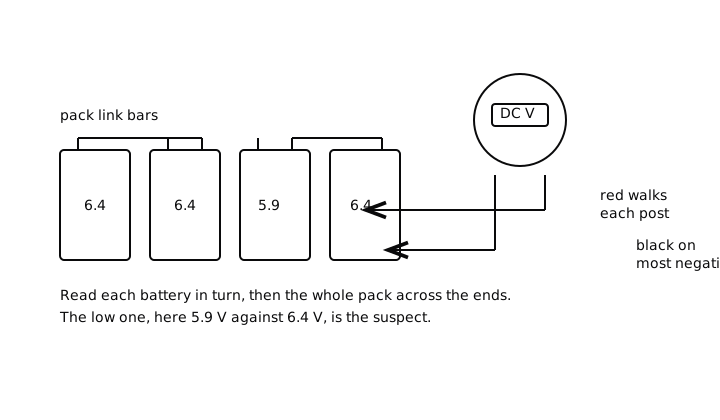
3Read the whole pack first
Place the black probe on the most negative terminal of the pack and the red probe on the most positive terminal, following the links from one end of the string to the other so you are truly across the whole pack.
ExpectedRested and fully charged, a 36 V pack reads about 38.2 V and a 48 V pack about 50.9 V. At roughly half charge a 36 V pack reads near 36.5 V and a 48 V pack near 48.7 V. A pack well under nominal is discharged, and the individual readings next will show whether that is even or the fault of one battery
4Read every battery in turn and write it down
Measure across the two posts of each battery along the string, red on positive and black on negative, and note the figure against the battery position. Work in order so you can see the pattern.
ExpectedRested and full, a 6 V battery reads 6.3 to 6.4 V, an 8 V battery 8.4 to 8.5 V and a 12 V battery 12.6 to 12.7 V, because a healthy lead-acid cell sits at about 2.12 V and there are three, four or six cells in those units. All the batteries should read within about 0.2 V of each other
5Compare the readings and flag the odd one
Look down your list for any battery sitting well below the rest. Small differences are normal; a large gap is not.
ExpectedA battery a volt or more below its neighbours, for example a 12 V unit reading 10.5 V in a pack where the others read 12.6 V, is the prime suspect and is likely pulling the whole pack down
6Load-test a suspect battery to confirm it
A rested reading can look acceptable yet collapse under load. With the pack charged, apply a known load by switching on the lights or driving the buggy a short distance on the flat, then read the suspect battery and a healthy one during the load.
ExpectedUnder load every battery sags a little, but a failing one sags far more: a suspect that holds within a few tenths of a volt of its neighbours is sound, while one that drops a volt or more below them under the same load is confirmed weak
Check it worked
7Confirm you have a clear verdict
Read back your notes. Either every battery is even and near its full rested figure, or one or more sit clearly low both at rest and under load.
ExpectedAn even, healthy set clears the pack of blame and points you elsewhere. A single low battery, confirmed under load, is your fault; replace it and, on an older pack, expect the remaining batteries to have limited life left because they have worked harder to compensate
When to book an engineer
Book an engineer if you find one weak battery in an otherwise good pack and want a matched replacement fitted and the whole set balanced, if several batteries read low and you are weighing a full pack replacement, or if the readings are even and healthy yet the buggy still misbehaves, which points at the charger, wiring or controller rather than the batteries. A meter tells you the state of the pack; it does not always tell you why, and an engineer can close that gap without you buying parts on a guess.
Common questions
What should each battery read when fully charged?
Rested and full, a 6 V battery reads 6.3 to 6.4 V, an 8 V battery 8.4 to 8.5 V and a 12 V battery 12.6 to 12.7 V. That is because a healthy lead-acid cell sits near 2.12 V and those batteries hold three, four and six cells.
What should the whole pack read?
A fully charged and rested 36 V pack reads about 38.2 V and a 48 V pack about 50.9 V. At roughly half charge a 36 V pack sits near 36.5 V and a 48 V pack near 48.7 V. Reading below those figures means the pack is discharged rather than necessarily faulty.
Do I have to wait before testing?
Yes. Straight off the charger a battery carries a surface charge that reads high and can hide a weak unit, and straight after a drive it reads low. Leave the pack to rest for a few hours, and overnight if you can, for a reading you can trust.
Can a battery read the right voltage and still be bad?
Yes, which is why the load test matters. A tired battery can recover a near-normal resting voltage yet collapse the moment it has to deliver current. Reading it under load, with the lights on or during a short drive, separates a genuinely healthy battery from one that only looks healthy at rest.
How much difference between batteries is too much?
Small differences of up to about 0.2 V across the set are normal. A battery a volt or more below its neighbours is the tell-tale of a failing unit that is dragging the pack down, and it should be confirmed under load before you replace it.
Should I replace one bad battery or the whole pack?
On a young pack a single matched replacement can be sound. On an older pack the surviving batteries have already worked harder to cover the weak one, so a single new battery is often outlived quickly by the tired ones around it, and a full set gives more even, longer service. Age and the spread of your readings decide it.
Did this fix it?
Every guide is written from manufacturer service documentation and workshop practice, then reviewed before publication. Read how we write and review our repair guides.