Golf buggy battery life and replacement signs
Written by the Hawke Electric Vehicles Service Team
Quick answer
A flooded lead-acid golf buggy pack that is well watered, correctly charged and not left flat commonly lasts around four to six years, but that figure moves a lot with how hard the buggy is used, how often it is charged, and whether the cells are kept topped up. The clearest signs of genuine ageing are steadily shorter range, a pack that charges quickly but sags under load, and several batteries reading low together after a full charge and rest. Before buying a new pack, rule out one failed battery dragging the rest down and a charging fault, because both mimic an old pack.
Tools needed
- Digital multimeter
- Hydrometer for flooded batteries
- Safety glasses
- Insulated gloves
- Distilled water
Confirm the pack is genuinely ageing
This guide is for deciding whether a buggy pack has reached the end of its life or whether something cheaper to fix is making it look tired. That distinction matters, because a single failed battery or a charging fault produces the same symptoms as an old pack, and replacing all the batteries when only one has failed, or when the charger is at fault, is an expensive way to solve the wrong problem.
Start by separating three possibilities. A genuinely old pack shows batteries that are all similar to each other and all somewhat low. One bad battery in an otherwise healthy pack shows a single unit well below its neighbours. A charging fault shows a pack that never reaches a proper full charge in the first place. If your buggy simply will not charge at all, you are on the wrong page and want the guide on a buggy that will not charge; if one battery is clearly the odd one out, see the guide on finding the one bad battery in a pack.
1Rest the pack, then read every battery
Charge fully, unplug, and let the pack rest for a few hours so surface charge settles. Then measure across the posts of each battery in turn and write the values down in order.
ExpectedRested and full, a 6 V battery reads 6.3 to 6.4 V, an 8 V battery 8.4 to 8.5 V and a 12 V battery 12.6 to 12.7 V. Batteries that are all a little low and close to each other point to age; one unit a volt or more below the rest points to a single failure, not a worn-out pack
How long a pack should last
A well kept flooded lead-acid pack commonly gives around four to six years of service, and that is the honest headline figure. It is a norm, not a guarantee, because battery life is set far more by how the pack is treated than by the calendar. A buggy charged after every use, kept topped up with distilled water and never left flat over winter can reach or pass the top of that range. A buggy run deeply flat, charged erratically and left dry can fall well short of the bottom of it.
So treat four to six years as a planning figure rather than a countdown. The reliable way to know where your pack stands is not its birthday but how it behaves: its range, how it holds voltage under load, and how evenly the batteries read. Those signatures, not an age, tell you whether replacement is due.
The signs an ageing pack actually shows
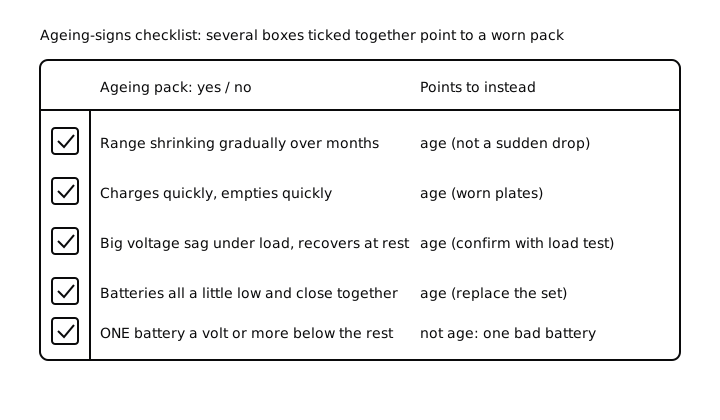
Ageing shows up as a pattern rather than a single dramatic failure, which is why it helps to look at the signatures together. The table below lists what a tired pack typically does and the check that confirms each one, so you can tell true wear from a fault wearing its disguise.
| Cause | How common | How to confirm | Fix |
|---|---|---|---|
| Range falls off steadily over months, not overnight | very common | Compare journeys you used to complete on a charge with what the buggy manages now | |
| Charges quickly but the charge does not last | very common | Note a short charge time followed by fast voltage sag once you drive; worn plates hold less | |
| Voltage sags heavily under load then recovers at rest | common | Read the pack at rest, then on a hill or under acceleration; a large drop that bounces back signals wear | How to test golf buggy batteries with a multimeter |
| Several batteries read low together after a full rest | common | Measure each battery; a cluster of low, similar readings is age, a single low one is a failure | How to test golf buggy batteries with a multimeter |
| Uneven specific gravity across cells on a flooded pack | common | Test each cell with a hydrometer after a full charge and rest; widely spread readings indicate wear | |
| Cases bulging, terminals heavily corroded or persistent water loss | occasional | Inspect for swelling, corrosion and cells needing frequent topping up despite correct charging |
Range that falls off steadily over months
The first and most useful sign of an ageing pack is range that shrinks gradually. A pack that once carried the buggy round a full course or a whole site now needs a top-up partway, and the change has crept in over months rather than appearing overnight. Sudden loss of range from one day to the next is more likely a single failed battery or a charging problem, so the key word for age is gradual.
Judge range against your own history, not a number on a page, because usage, terrain, load and temperature all move it. If you can remember journeys you used to complete comfortably and the buggy now cannot, and the decline has been slow and steady, that is a classic ageing signature.
Charges quickly but does not hold
As lead-acid plates wear, the battery stores less energy, so it fills up sooner and empties sooner. Owners often read the short charge time as good news when it is the opposite: a pack that used to take a full night and now finishes in a fraction of the time is usually holding a fraction of the charge. The tell is the pairing of a quick charge with a quick discharge once the buggy is working.
2Watch how fast voltage falls under use
With a full, rested pack, note the resting voltage, then drive normally and re-check. An ageing pack loses voltage quickly and does not return to full even after resting.
ExpectedA healthy pack holds up well and settles back near full at rest; a worn pack sags fast under load and rests low, for example a 48 V pack that will not settle much above the low 48 V region even after a full charge
Voltage that sags under load then recovers
A characteristic of tired batteries is a large voltage drop the moment they are asked to deliver current, followed by a recovery once the load is removed. On the flat the buggy may seem fine, but a hill or hard acceleration pulls the voltage down sharply, and it climbs back when you ease off. The under-load test in the guide on testing batteries with a multimeter puts a number on this and is the fairest single measure of remaining capacity.
Do not judge a pack on its rested voltage alone, because a worn battery can read almost normal at rest and still collapse under load. It is the behaviour under load that separates a pack with life left from one that is finished.
Several batteries reading low together
This is the check that most cleanly separates age from a single failure. Measure every battery after a full charge and a rest and lay the readings out in order. If they are all a little below the full-charge figures and close to one another, the whole pack has worn together and replacing the set is reasonable. If one battery sits a volt or more below the rest while the others look healthy, you have a single failure dragging the pack down, and the guide on finding the one bad battery is the place to go before you spend on a full set.
3Confirm with a hydrometer on flooded packs
On flooded batteries, after a full charge and rest, draw electrolyte from each cell into a hydrometer and compare the specific gravity readings across the whole pack.
ExpectedA fully charged healthy cell reads around 1.265 to 1.28 specific gravity, corrected for temperature. Readings that are uniformly low, or spread widely between cells, both point to a pack that is worn out
Physical signs and water loss
Some ageing shows without a meter. Cases that bulge, terminals that stay heavily corroded after cleaning, and cells that need topping up far more often than they used to despite a correct charge are all end-of-life signals. Frequent water loss in particular suggests the charger is pushing the pack too hard or the batteries are worn, and either way it shortens what life remains. A battery that is cracked, swollen or leaking should be taken out of service on safety grounds regardless of its voltage.
When to book an engineer
Book an engineer if the pattern is mixed and you cannot tell age from a single failure or a charging fault, if the pack reads worn but you want a load or capacity test to confirm before buying, or if you suspect the charger is overcharging and cooking the batteries. Replacing a whole pack is a significant cost, and it is worth a proper test first, because the answer is sometimes one battery or a charger setting rather than six new batteries.
Common questions
How long do golf buggy batteries last?
A well maintained flooded lead-acid pack commonly lasts around four to six years, but that is a norm rather than a promise. Regular charging, keeping the cells topped up with distilled water and avoiding deep discharges push life towards the top of the range, while heavy use, erratic charging and running the pack flat cut it short.
What is the single clearest sign my pack is worn out?
Steadily shrinking range over months, paired with a pack that charges quickly but sags under load, is the clearest signature of genuine ageing. Confirm it by measuring every battery after a full charge and rest: a cluster of low, similar readings means the pack has worn together.
Could it be one bad battery rather than the whole pack?
Yes, and it often is. One battery reading a volt or more below its neighbours after a full charge and rest is a single failure dragging the pack down, not general wear. Replacing that one unit, or at least confirming it before buying a full set, can save most of the cost.
What should a fully charged battery read after resting?
Rested and full, a 6 V battery reads 6.3 to 6.4 V, an 8 V battery 8.4 to 8.5 V and a 12 V battery 12.6 to 12.7 V. On a flooded pack, a healthy fully charged cell reads about 1.265 to 1.28 specific gravity on a hydrometer, corrected for temperature.
Does charging quickly mean the batteries are healthy?
Usually the opposite. As plates wear the battery holds less energy, so it fills sooner and empties sooner. A pack that once needed a full night and now charges in a fraction of the time is often storing a fraction of the charge.
Can I extend the life of the pack I have?
Good habits help what life remains: charge fully after use, keep flooded cells topped up with distilled water above the plates, avoid running the pack deeply flat, and keep terminals clean. None of this reverses worn plates, but it stops a healthy pack from ageing before its time.
Did this fix it?
Every guide is written from manufacturer service documentation and workshop practice, then reviewed before publication. Read how we write and review our repair guides.