Golf cart hesitates when accelerating: causes
Written by the Hawke Electric Vehicles Service Team
Quick answer
A golf cart that lags for a moment before it responds to the pedal most often has a worn or dirty throttle sensor, a poor connection in the throttle circuit, or a controller that is limiting the response. Start by reading any controller fault code, then test the throttle sensor output as you press the pedal, because a signal that jumps or dead-spots is the usual cause. Weak battery voltage under load can also make a cart feel hesitant, so rule that out too.
Tools needed
- Digital multimeter
- The controller or vehicle manual
- Contact cleaner
- Safety glasses
- Wheel chocks
Parts needed
- Throttle sensor if worn
- New throttle connector or terminals if corroded
Confirm the symptom
This guide covers a cart that pauses or lags for a beat when you press the pedal from rest, then picks up, or that responds unevenly through the travel. Try it several times and note whether the delay is always there or comes and goes, and whether it happens only from a standstill or throughout.
If instead the cart surges and jerks all the way through acceleration, see the jerky acceleration guide, which shares causes but is a different symptom. If it has dropped into a reduced-power state with a warning, read the controller fault code first with the fault code guide. Come back here for a cart that simply lags before it responds.
What causes it
| Cause | How common | How to confirm | Fix |
|---|---|---|---|
| Worn or dirty throttle sensor | very common | Read the sensor output as you press the pedal for dead spots or jumps | |
| Poor connection in the throttle circuit | common | Inspect and clean the throttle connector and wiggle-test for a dropout | |
| Controller limiting or fault | common | Read the controller fault code and check its settings | How to read golf cart controller fault codes |
| Weak battery voltage under load | occasional | Watch pack voltage sag as you apply the pedal | How to test golf cart batteries with a multimeter |
| Sticking or misadjusted pedal linkage | occasional | Check the pedal and linkage move freely and reach full travel |
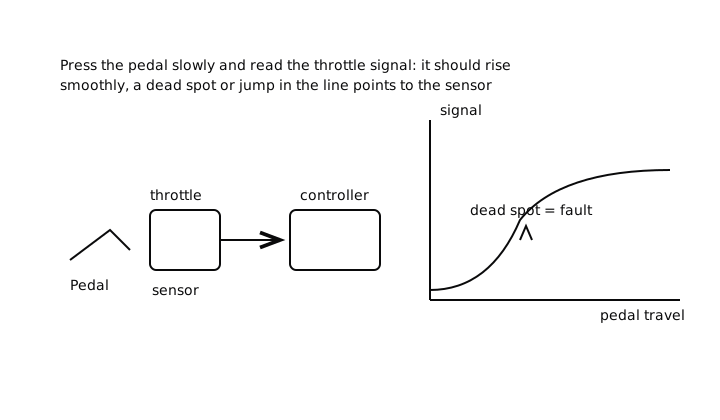
Worn or dirty throttle sensor
The throttle sensor tells the controller how far the pedal is pressed. On older potentiometer types a worn track causes dead spots and jumps; on inductive types such as an E-Z-GO ITS the element does not wear the same way, but a fault or a poor connection still upsets the signal. A signal that does not rise smoothly makes the controller hesitate.
1Read the throttle output through the travel
With the manual open for the correct test points and the cart safely supported, back-probe the sensor signal with a multimeter and press the pedal slowly from rest to full travel, watching the reading.
ExpectedA smooth, steady rise across the whole travel; any dead spot, jump or dropout points to a worn or faulty sensor
Poor connection in the throttle circuit
A corroded or loose throttle connector gives the same lag as a worn sensor, because the signal drops out for a moment. This is quick to check and worth doing before condemning the sensor itself.
2Inspect, clean and wiggle-test the connector
Unplug the throttle connector with the key off, inspect for corrosion or spread terminals, clean it with contact cleaner, and reconnect. Then, while reading the signal, gently wiggle the connector and harness.
ExpectedClean, tight terminals and a steady signal that does not flicker as you wiggle the connector; a flicker locates a bad connection
Controller limiting or fault
The controller can deliberately limit response, for example in a reduced-power mode, or it can be reporting a throttle fault. Reading the code with the fault code guide tells you whether the controller sees a throttle problem or is limiting for another reason such as temperature or voltage.
3Read the controller code and settings
Read any fault code the controller is showing, and note whether it points to the throttle or to a limiting condition. Follow the fault code guide to interpret it for your controller.
ExpectedEither a throttle-related code, which confirms the sensor circuit, or a limiting condition such as over-temperature or low voltage to chase instead
Weak battery or sticking linkage
A pack that sags hard under load can make a cart feel hesitant, so if the batteries are due a test, check pack voltage under load with the battery voltage guide. Finally, a pedal or linkage that sticks or does not reach full travel gives an uneven response and is the simplest thing to rule out.
4Check voltage sag and the pedal travel
Watch the pack voltage as you apply load, and separately check the pedal and linkage move freely to full travel without binding.
ExpectedPack voltage that holds up reasonably under load and a pedal that moves freely to full travel; heavy sag or a sticking pedal identifies the fault
When to get professional help
Get a professional if the throttle signal is faulty and you are not confident replacing and setting up the sensor, if the code points to an internal controller fault, or if the hesitation continues after the throttle and connections check out. Throttle and controller faults sit close to the drive system, and setting up a replacement sensor correctly matters for smooth response. A technician can test the throttle, controller and pack together and fit what is needed.
Common questions
Why does my golf cart hesitate before it moves?
The usual cause is the throttle sensor or its connection: a worn potentiometer, a faulty inductive sensor, or a corroded connector gives the controller an uneven signal, so it lags. Read the throttle output as you press the pedal, and clean the connector, before looking at the controller or the batteries.
How do I test a golf cart throttle sensor?
With the vehicle safely supported and the manual open for the correct test points, back-probe the sensor signal with a multimeter and press the pedal slowly from rest to full. A healthy sensor gives a smooth, steady rise. A dead spot, a jump or a dropout in the reading points to a worn or faulty sensor.
What is an ITS throttle?
ITS stands for inductive throttle sensor, used on some E-Z-GO models. Unlike an older potentiometer it has no wiper track to wear, so it tends to last well, but it can still fail electrically or suffer a poor connection. Test its output the same way, by reading the signal through the pedal travel.
Can a weak battery cause hesitation?
Yes. A pack that sags hard under load leaves the controller short of the voltage it wants, which can feel like hesitation, especially on hills or from rest. If the batteries are aging or due a test, check the pack voltage under load before spending on throttle parts.
Is it safe to drive with a hesitating pedal?
A mild lag is a nuisance, but an uneven throttle signal can also cause sudden unexpected surges, which is a control risk. If the hesitation is getting worse or comes with jerky pickup, have the throttle circuit checked rather than driving on it, particularly around people or on slopes.
Guided check
Diagnose it step by step
Answer a few questions and we will point you at the most likely cause.
Question 1 of 3
Is it worst pulling away from a stop?
Did this fix it?
Every guide is written from manufacturer service documentation and workshop practice, then reviewed before publication. Read how we write and review our repair guides.