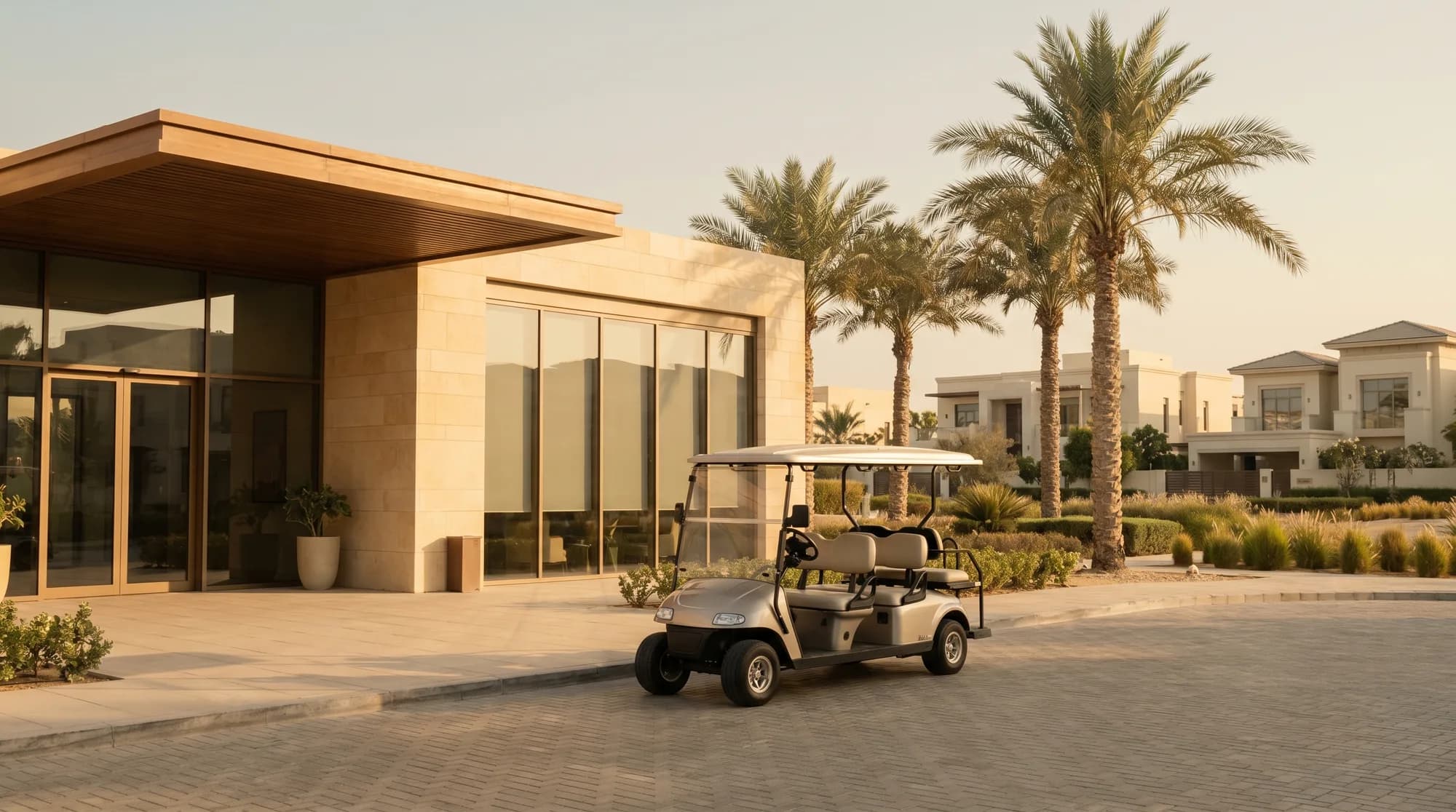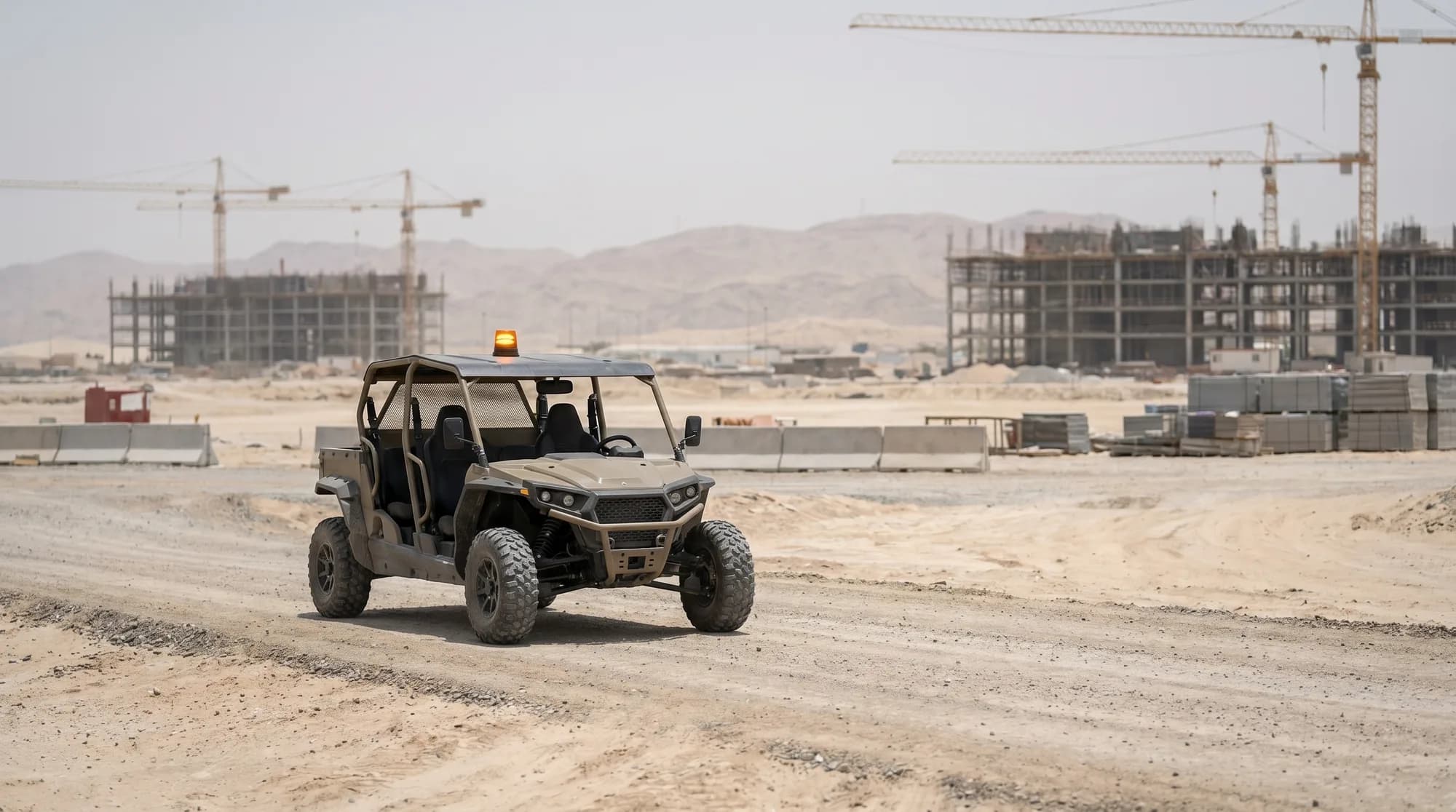
UAE construction and industrial sites are enormous. A major project, a logistics free zone or an industrial estate can stretch across a vast footprint, and the walk from the gate or site office to the active work face wastes time and, in the heat, drains the workforce before they even start. Electric personnel carriers and utility golf carts fix that: they move crews quickly between the office, welfare facilities and the work face, and carry tools, materials and equipment to where they are needed without tying up a forklift or a truck.
These are working vehicles in a demanding, safety-critical environment. They share the site with heavy plant, they breathe dust all day, and they bake in the sun. A cart here is judged on safety, durability and uptime, not on looks. Get the specification and the rules right and it becomes one of the quietest productivity gains on the project. The same operator thinking drives cart use in warehouses and logistics and airside at UAE airports.
- Safety leads everything on a construction or industrial site: speed control, visibility, lights, audible warning and trained drivers.
- Match the vehicle to the task: personnel carriers for crews, utility golf carts for tools and materials.
- Heat and dust durability decides longevity: sealed components, protected electrics and a heat-tolerant lithium pack.
- On large projects and free zones such as JAFZA and the DWC, golf carts recover huge amounts of lost walking time.
- Charging strategy keeps a multi-shift site moving: opportunity charging plus quick lithium recovery.
- Confirm site safety rules, permitted routes and free-zone or HSE requirements with the operator before deployment.
Why big sites need site transport
The economics are simple. On a sprawling site, every worker who walks ten minutes to the work face and ten minutes back loses real productive time on every trip, and arrives tired in the heat. Multiply that across a large crew and several trips a day and the lost hours are substantial. A personnel carrier collapses that journey and keeps the workforce fresher, which improves both output and safety.
Material movement is the second case. A utility cart with a cargo bed shifts tools, fixings, samples and small loads between stores, the office and the work face far more efficiently than carrying them by hand or commandeering a forklift that is needed elsewhere. On a free-zone project, the same logic extends to moving people and parts across an industrial campus, and across a completed development it feeds into the wider facilities management fleet.
Safety in a plant environment
A construction or industrial site is one of the most hazardous workplaces there is, shared with cranes, excavators, trucks and pedestrians. A cart has to slot into a strict safety regime. That means controlled speed, conspicuous visibility, lights and a clear audible warning, seatbelts where fitted, and disciplined use of designated routes that keep golf carts clear of heavy plant and pedestrian zones. Only trained, authorised drivers should operate them.
- 01
Set and limit speed
Limit cart speed to the site rules so it moves safely among plant and pedestrians.
- 02
Make it conspicuous
Fit lights, reflectors, a beacon where required and an audible warning so the cart is always seen and heard.
- 03
Define the routes
Use designated, segregated routes that keep golf carts clear of heavy plant and pedestrian areas.
- 04
Authorise the drivers
Allow only trained, authorised operators to drive, in line with the site safety regime.
Surviving heat and dust
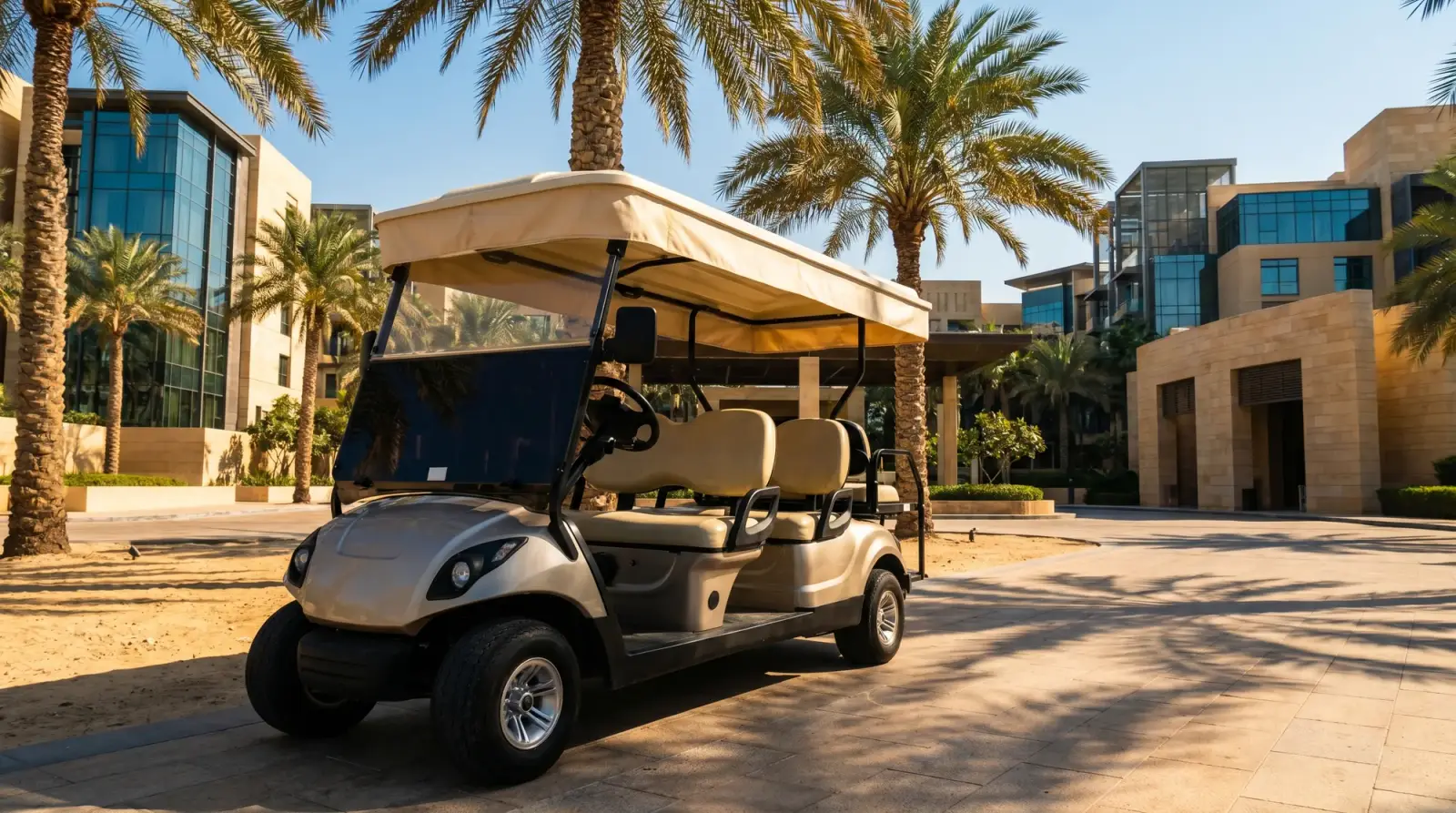
A construction cart lives in the two things that destroy cheap machinery fastest in the UAE: heat and dust. Fine site dust works into controllers, connectors, bearings and brakes, and the sun bakes everything year-round. The golf carts that survive are sealed against ingress, run a heat-tolerant lithium pack, and use protected electrics and components chosen for an industrial life rather than a gentle one.
- What it attacks
- Controllers, bearings, brakes
- The defence
- Sealed components and protected electronics
- What it attacks
- Battery life and electronics
- The defence
- Heat-tolerant lithium pack and good ventilation
- What it attacks
- Frame, suspension, drivetrain
- The defence
- Rugged build rated for industrial duty
| What it attacks | The defence | |
|---|---|---|
| Fine site dust | Controllers, bearings, brakes | Sealed components and protected electronics |
| Sustained heat | Battery life and electronics | Heat-tolerant lithium pack and good ventilation |
| Hard daily use | Frame, suspension, drivetrain | Rugged build rated for industrial duty |
Personnel carriers versus utility golf carts
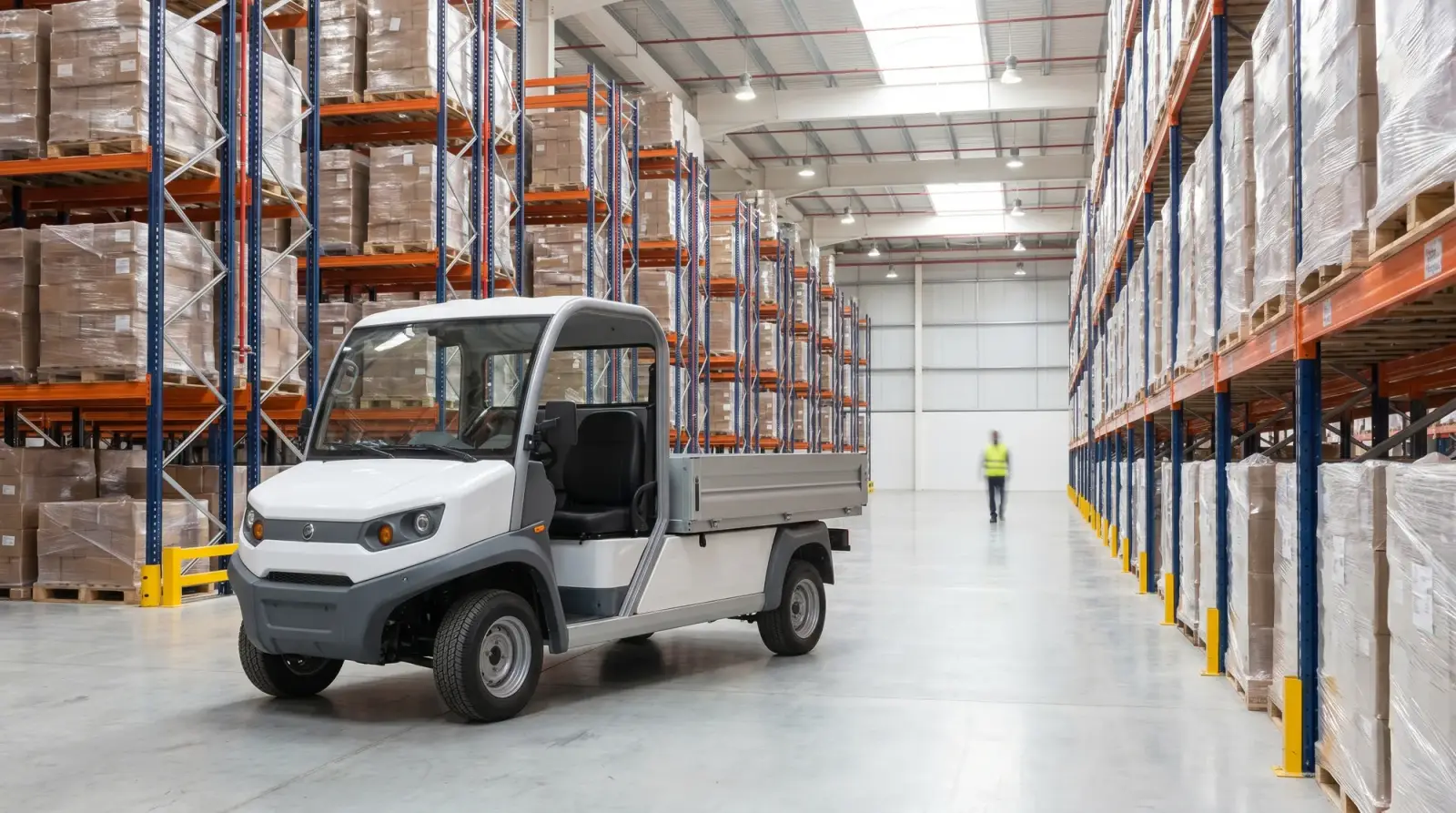
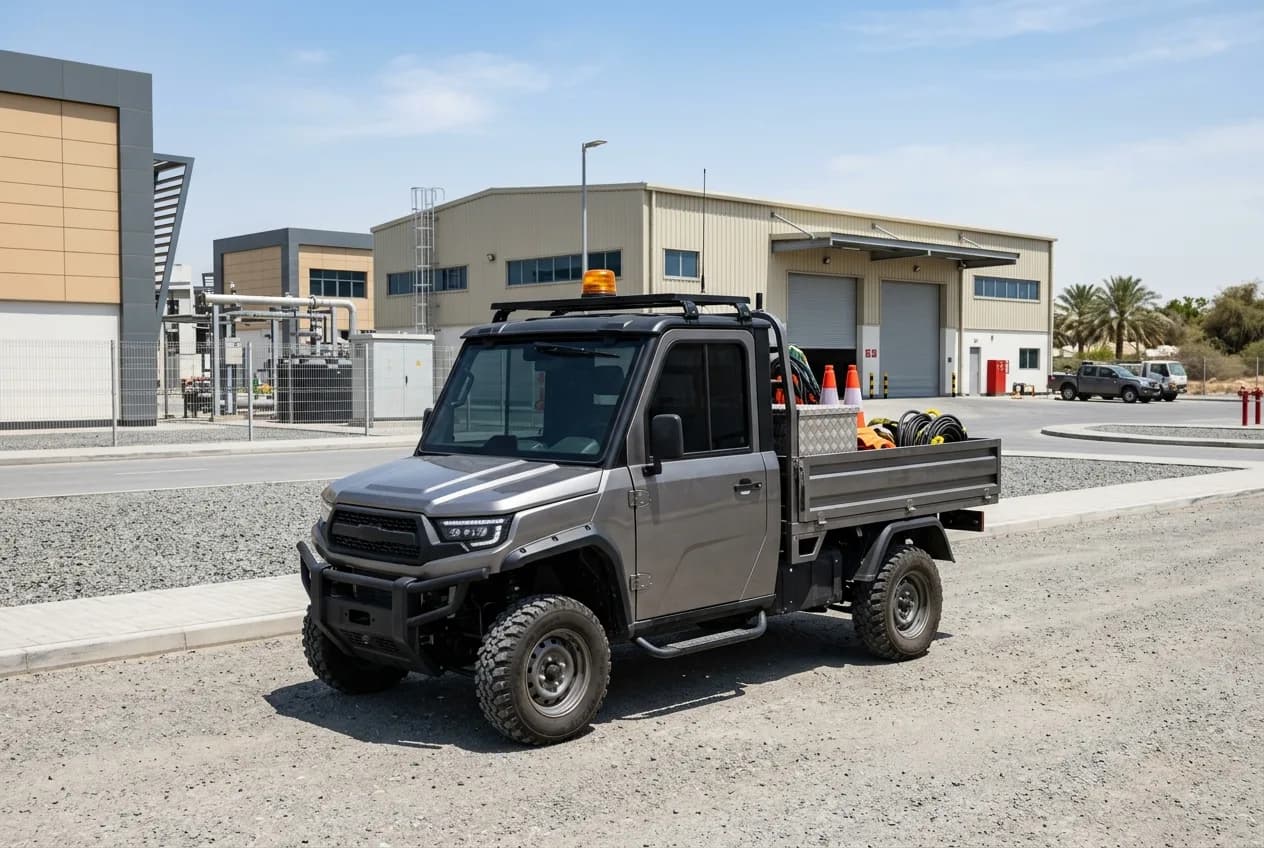
Most sites run a mix. A personnel carrier is built to seat several workers safely for quick transfers across the site. A utility cart trades some seating for a cargo bed to carry tools and materials. A few configurations do both, with a crew bench and a load area. Match the fleet to the work: how many people move, how often, and how much they need to carry with them.
- Personnel carrier: seats a crew for fast, safe internal transfers.
- Utility cart: cargo bed for tools, fixings and light materials.
- Combination: crew seating plus a load area for mixed duties.
- Spare capacity: hold one back to cover servicing and downtime.
Charging and total cost
Sites often run long or multiple shifts, so charging has to fit around the work. Opportunity charging during breaks, charge points near the site office and welfare area, and lithium packs that recover quickly keep the fleet available without a long downtime. On the cost side, electric wins clearly: no fuel, few moving parts and low maintenance, set against the productivity recovered by keeping crews off their feet. Judge the investment on uptime and recovered hours, and for indicative figures see how much a golf cart costs in the UAE before pricing a configuration via /request-a-quote.
Welfare, heat and the workforce
In a UAE summer the heat is not just uncomfortable on a construction site; it is a serious health risk, and the country's midday work restrictions exist for that reason. A cart plays a quiet role in managing it. Cutting the long, exposed walk to the work face reduces heat exposure and exertion, and a cart on standby can move a worker showing signs of heat stress to a cool welfare area or a medic far faster than a stretcher carry across a large site. Specifying a cart with a canopy and, where useful, a stretcher-capable or first-aid configuration turns it into part of the site's welfare provision.
There is a morale dimension too. A workforce that is not worn out before it reaches the task, and that sees its employer investing in sensible site transport, tends to be more productive and to stay longer. On large, long-running projects those soft gains add up, and they sit alongside the hard productivity numbers that justify the fleet in the first place.
Specify a construction-site cart fleet
Tell us your site size, shift pattern, safety requirements and tasks, and we will configure rugged personnel carriers and utility golf carts with current indicative pricing in AED.
Frequently asked questions
Are golf carts safe to use on construction sites?+
Yes, when integrated into the site safety regime. That means controlled speed, good visibility, lights and audible warning, seatbelts where fitted, trained authorised drivers and disciplined use of routes segregated from heavy plant and pedestrians.
Can golf carts handle UAE construction-site dust and heat?+
A properly specified one can. Look for sealed components, protected electrics, a heat-tolerant lithium pack and a rugged build rated for industrial duty, since fine dust and sustained heat destroy cheaper machinery quickly.
Do free zones allow golf carts on industrial sites?+
They are widely used, but free zones such as JAFZA and the DWC and individual sites set their own HSE and traffic rules. Confirm permitted vehicles, routes, PPE and driver requirements with the operator and authority first.
What is the difference between a personnel carrier and a utility cart here?+
A personnel carrier seats a crew for fast internal transfers, while a utility cart has a cargo bed for tools and materials. Many sites run a mix, and some configurations combine crew seating with a load area.
How are golf carts charged on a multi-shift site?+
With opportunity charging during breaks, charge points near the site office and welfare area, and lithium packs that recover quickly so the fleet stays available without long downtime.
Related solutions
Ready to explore what we build?
See the vehicles and the setting this applies to, or get a tailored quote built around your site.
Ready to find the right golf cart?
Tell us how and where it will work and we will specify a vehicle and a tailored quote built around you. Every build comes with a 3-year warranty and a 24-hour priority call-out.
Our guides are written and reviewed by the Hawke Electric Vehicles team, the people who specify, build, deliver and support the vehicles. We focus on honest, practical advice and flag where a figure depends on the build rather than guessing.
More guides by Hawke