Sooner or later most cart owners need to move one: to a repair shop, a second home, a tournament, a campsite or a new address. It looks simple, and the basic act of rolling a cart onto a trailer is, but the details that make it safe are easy to get wrong. The wrong trailer, an underrated hitch, a missed tie-down point or a steep ramp can turn a quick move into a damaged cart, a damaged tow vehicle, or a hazard on the highway. This guide covers the parts that actually matter: sizing a trailer to the cart, matching the hitch and the tow vehicle, loading safely, and choosing between a trailer, a flatbed and towing the cart directly.
- Size the trailer to your cart's length and weight, including any lift, big tires or rear seat that adds bulk.
- Know your cart's weight; electric carts with their battery pack are heavier than people expect.
- Match the trailer plus loaded cart weight to your hitch class and the tow vehicle's rating, with margin.
- Use the cart's designed tie-down points and four straps, not two, securing the cart itself, not just the wheels.
- Most carts should be trailered or flatbedded; towing a cart on its own wheels is rarely a good idea.
Know your cart's weight first
Everything else flows from one number you probably do not know: how much your cart weighs. People assume a golf cart is light, but an electric cart carries a heavy battery pack, and a typical two-passenger can weigh several hundred pounds before you add a rear seat, a lift kit, bigger tires or a roof. A four- or six-passenger is heavier still. Find the curb weight in your owner's manual or on the data plate, then add whatever accessories and cargo will travel with it. That total is what your trailer, straps, ramp and hitch all have to handle. Choosing the cart that fits your needs in the first place, covered in what size golf cart you need, also shapes how easy it is to move.
Sizing the trailer
A trailer has to fit the cart in two dimensions and carry it in a third. Measure your cart's overall length and width, remembering that a lift kit and oversized tires make it both longer and wider than the stock figures suggest, and a rear-facing seat adds length. Then check the trailer's payload capacity against your cart's loaded weight. A trailer rated only just above your cart leaves no margin and stresses every component, so choose one with comfortable headroom.
- Type
- Single cart, occasional moves
- Best for
- Cheapest, exposes cart to weather
- Type
- Frequent moves, protection
- Best for
- Pricier, keeps cart secure and dry
- Type
- Multiple carts, easy loading
- Best for
- Needs a capable tow vehicle
- Type
- One cart, light and easy
- Best for
- Sized exactly, often foldable
| Type | Best for | |
|---|---|---|
| Open utility trailer | Single cart, occasional moves | Cheapest, exposes cart to weather |
| Enclosed trailer | Frequent moves, protection | Pricier, keeps cart secure and dry |
| Flatbed / deck | Multiple carts, easy loading | Needs a capable tow vehicle |
| Cart-specific trailer | One cart, light and easy | Sized exactly, often foldable |
Hitch class and the tow vehicle
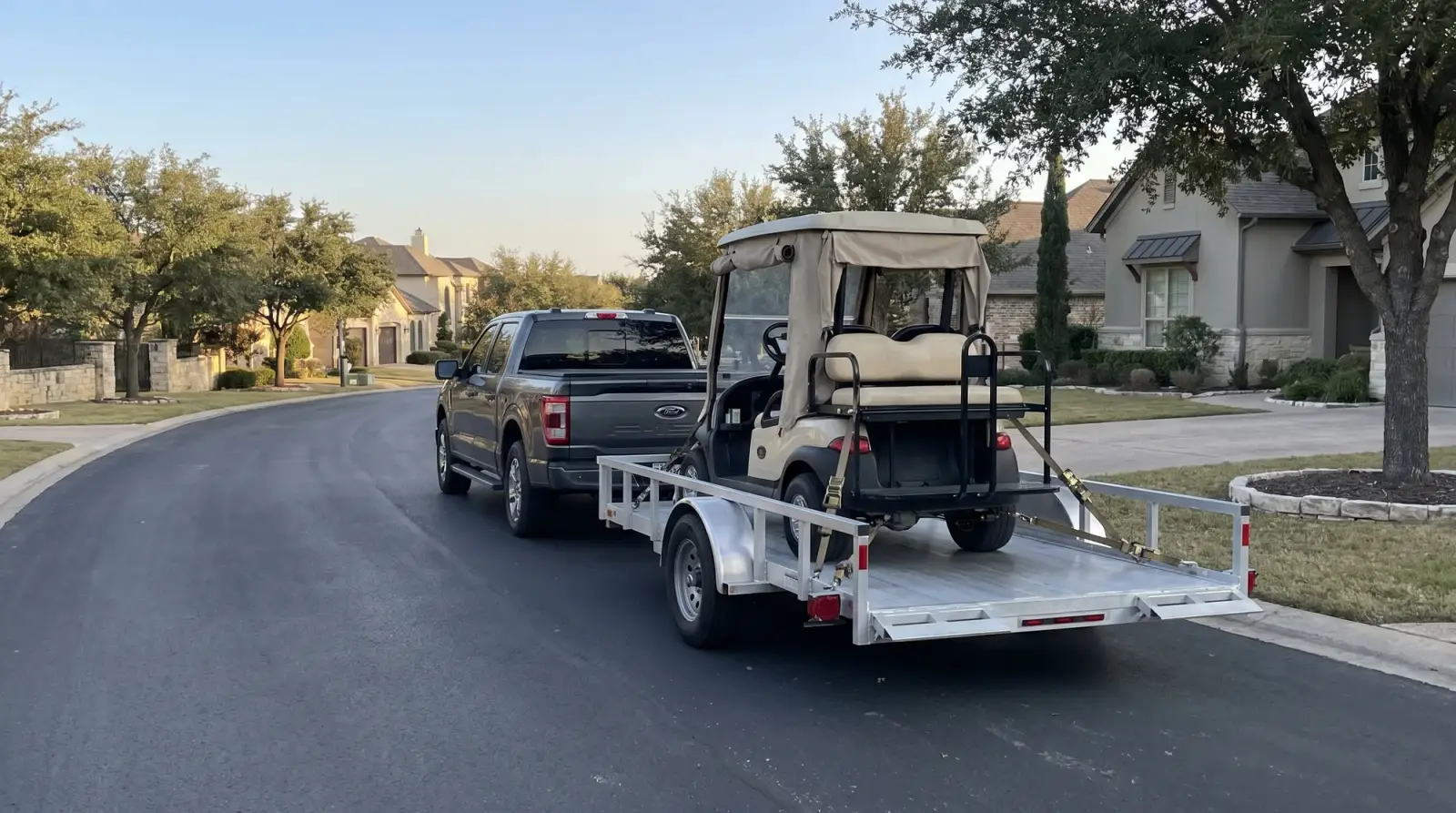
The weakest link in towing is whatever is rated lowest, so all three things must match: the hitch, the tow vehicle and the loaded trailer. Trailer hitches are sold in classes, each with a maximum weight it is rated to pull. Add the trailer's own weight to your loaded cart's weight to get the total you are towing, then confirm both your hitch class and your tow vehicle's towing capacity comfortably exceed it. A light SUV can usually handle a single cart on a small trailer; multiple carts or an enclosed trailer may need a truck.
Do not forget the ball size, the wiring for the trailer's lights, and the trailer's own brake requirements if it is heavy enough to need them. A trailer with no working lights is both illegal and dangerous, and mismatched ball and coupler sizes are a classic cause of a trailer coming loose. If you run several carts that move between sites, our fleet management guide covers the logistics of transport and uptime across a fleet.
Loading and tying down safely
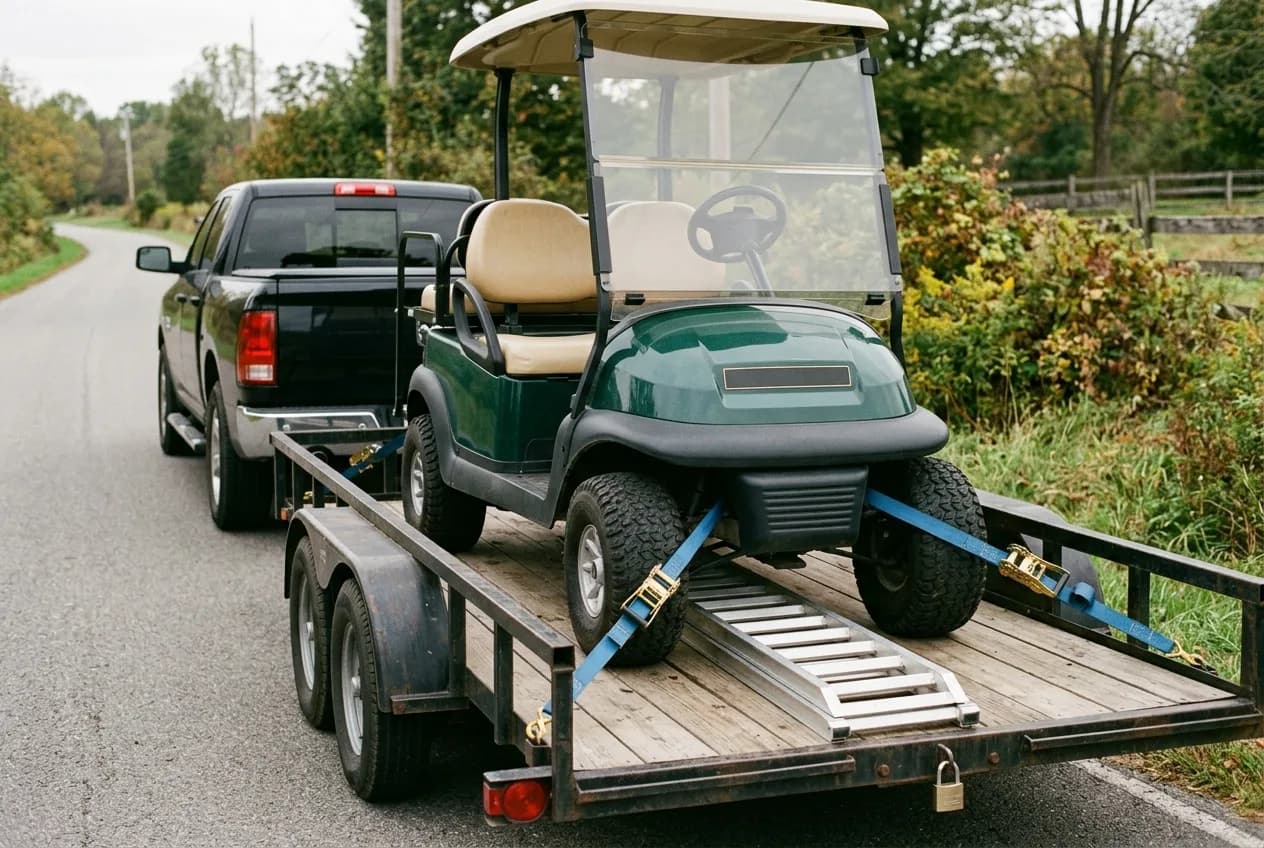
More carts are damaged in loading and transit than in any other part of a move, and almost all of it is preventable. The two things that matter most are a safe ramp angle while loading and proper tie-downs once the cart is aboard.
- 01
Use a long enough ramp
A steep ramp can high-center a low cart or cause it to tip. Use ramps long enough for a gentle angle, rated above the cart's weight, and never rush the drive-up.
- 02
Position and set the brake
Center the cart on the trailer for balanced tongue weight, put it in park or neutral as your tie-down method requires, and set the parking brake.
- 03
Use four straps and real anchor points
Secure the cart with at least four ratchet straps to the trailer's anchor points, attaching to the cart's frame or designed tie-down points, not to suspension, steering or thin body panels.
- 04
Cross or angle for stability
Run straps forward and back so the cart cannot slide or rock in any direction, and snug them firmly without crushing the suspension solid.
- 05
Check again before and during the trip
Recheck every strap before you set off, then again after the first few miles, since straps loosen as the cart settles.
Trailer, flatbed or tow it directly?
There are three ways to move a cart, and they are not equally good. A trailer is the standard, safe choice for most owners and keeps the cart off its own running gear. A flatbed or deck makes sense when you move several carts or want the easiest loading, but needs a capable vehicle. Towing a cart directly on its own wheels behind another vehicle, sometimes called flat towing, is the one to be wary of: most electric carts are not designed to be flat towed at road speed, and doing so can damage the motor, transmission or controller, quite apart from the steering and braking risk of an unmanned cart on the road.
- Trailer: safest and most common for a single cart; choose open for cost or enclosed for protection.
- Flatbed or deck: best for multiple carts or easy loading, but needs a truck and good securing.
- Flat towing on its own wheels: generally not recommended for electric carts; check the manual, as it can damage the drivetrain.
- Professional transport: worth it for long moves, valuable carts or when you lack a suitable tow vehicle.
Whichever you choose, a cart that is mechanically sound travels better and loads more safely, so it is worth a quick look over the brakes and tires from our maintenance and repair basics before a big move, and the tires and wheels guide helps you confirm the tires are sound for the journey.
The carts that arrive damaged are almost never damaged by the road. They are damaged by a steep ramp, two lazy straps, or someone who never checked the weight before hitching up.
So what should you do?
Start by finding your cart's real loaded weight and dimensions, including any mods. Pick a trailer rated comfortably above that, match the hitch class and tow vehicle with margin, and confirm the trailer lights and brakes work. Load on a gentle ramp, secure the cart with at least four straps to solid anchor points, and recheck early in the trip. Avoid flat towing an electric cart on its own wheels. If you are speccing a new cart and transport is part of your life, we can advise on weight and dimensions up front, with honest numbers.
Need a cart that suits your transport setup?
Tell us how you will move and use the cart, and we will recommend a build sized for it, with honest weight and dimension figures.
Frequently asked questions
What size trailer do I need for a golf cart?+
Size the trailer to your cart's actual length, width and loaded weight, remembering that a lift kit, oversized tires and extra seats add bulk. Choose a trailer with payload capacity comfortably above your cart's loaded weight, not just barely over it.
How much does a golf cart weigh for towing?+
It varies, but an electric two-passenger typically weighs several hundred pounds thanks to its battery pack, and four- or six-seaters weigh considerably more. Always check the curb weight on the data plate or in the manual, then add accessories and cargo.
How do I tie down a golf cart on a trailer?+
Center the cart for balanced weight, set the parking brake, and use at least four ratchet straps to the trailer's anchor points, attaching to the cart's frame or designed tie-down points, not the suspension or body panels. Recheck the straps before and shortly after setting off.
Can you flat tow a golf cart on its own wheels?+
Generally it is not recommended for electric carts. Many are not designed to be towed at road speed on their own wheels, and doing so can damage the motor, transmission or controller. Use a trailer or flatbed, and always check your owner's manual first.
What hitch class do I need to tow a golf cart?+
Add the trailer's weight to your loaded cart's weight, then choose a hitch class and a tow vehicle whose ratings both comfortably exceed that total. Confirm the ball size matches the coupler and that the trailer's lights, and brakes if required, are working.
Related solutions
Ready to explore what we build?
See the vehicles and the setting this applies to, or get a tailored quote built around your site.

Ready to find the right golf cart?
Tell us how and where it will work and we will specify a vehicle and a tailored quote built around you. Every build comes with a 3-year warranty and a 24-hour priority call-out.
Our guides are written and reviewed by the Hawke Electric Vehicles team, the people who specify, build, deliver and support the vehicles. We focus on honest, practical advice and flag where a figure depends on the build rather than guessing.
More guides by Hawke