Golf cart won't start: causes and fixes
Written by the Hawke Electric Vehicles Service Team
Quick answer
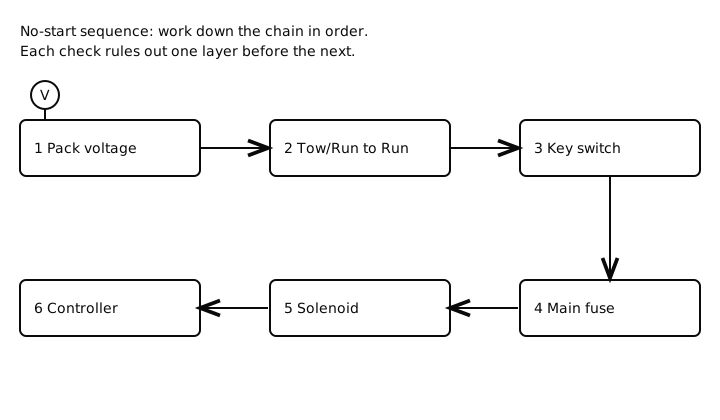
When a golf cart shows no response at all to the key or the pedal, power is usually being lost upstream of the controls. The likeliest reasons, in order, are a dead or disconnected battery pack, a Tow/Run switch still set to Tow, a blown main fuse and a failed key switch. Begin with a rested pack voltage reading, then verify the Tow/Run switch is in Run before going further.
Tools needed
- Digital multimeter
- Safety glasses
- Insulated gloves
- Work light
Parts needed
- Replacement main fuse, rating as printed on the holder
Confirm the symptom
This master guide is for a golf cart that gives you nothing when you switch on and press the pedal: no dash lights, no battery meter reading, no click from under the seat and no motion. It runs the no-start chain in the order a technician uses, so each check clears one layer of the system before you reach the next. Order is the whole point here, because a dead pack and a failed controller feel the same from the seat, and only the sequence separates them.
Confirm you are on the right page first. If the dash lights and meter come on but the cart still will not drive, power is getting through and the guide you want is Powers on but won't move. If the pedal produces one click from under the seat and nothing else, go to Solenoid clicks but no movement. If there is no click at all with the lights on, go to No click when pressing the pedal. And if the cart is really failing to charge rather than to start, see Golf cart not charging, since a pack that never charged will never start.
1Switch on and read the dash
Turn the key or press the run button and watch the dash lights and the battery meter.
ExpectedNothing lighting up keeps the fault on the supply side: pack, main connections, Tow/Run switch, main fuse or key switch. Lights coming on push the fault down the chain toward the solenoid and controller.
2Press the pedal and listen
With the Tow/Run switch in Run, press the accelerator and listen for a click from the solenoid under the seat.
ExpectedA clear click tells you the coil circuit works, so you focus on the contacts, controller and motor. No click keeps you on the coil circuit, key switch and fuse.
What causes it
| Cause | How common | How to confirm | Fix |
|---|---|---|---|
| Dead pack or an open main connection | very common | Measure rested pack voltage at the terminals and check the main cables | How to test golf cart batteries with a multimeter |
| Tow/Run switch left in the Tow position | very common | Set the switch to Run, wait ten seconds and try again | |
| Blown main fuse or tripped breaker | common | Find the main fuse and continuity-test it | |
| Bad key switch or loose spade terminals | common | Back-probe the key switch output with the key on | |
| Solenoid not closing or contacts burned | common | Listen for a click, then voltage-test across the large terminals | How to test a golf cart solenoid |
| Controller or its throttle input | occasional | Clear everything above, then read controller status where fitted | How to reset a golf cart: step-by-step reset guide |
A dead or disconnected battery pack
The simplest cause is also the most common: the pack holds no usable charge, or the current has no path out of it. Left for weeks a pack self-discharges, and a single failed battery can drag the whole set under the voltage the controls need to come alive. Loose or corroded main terminals do the same by opening the circuit before it reaches the controller.
3Read rested pack voltage at the terminals
With the charger unplugged and the cart off, set a multimeter to DC volts and measure across the whole pack, most positive post to most negative.
ExpectedRested and healthy, a 36 V pack reads about 38.2 V and a 48 V pack about 50.9 V. Near 36.5 V or 48.7 V is around half charge. A reading well under that, or close to zero, means the pack is dead or the circuit is open.
4Inspect the main cables and terminals
Check the main positive and negative cables and every interconnect for looseness, green or white corrosion, or heat damage, and snug up any terminal that moves.
ExpectedFull voltage at the batteries but none reaching the controller means an open main connection. A loose, corroded or warm terminal is the likely break.
A pack that is only discharged comes back with a full charge, then test again. The multimeter battery guide shows how to read each battery to catch one that is pulling the set down, and the terminal corrosion guide covers cleaning and protecting the posts. A battery that will not hold voltage after a full charge has failed, and the pack will keep failing until it is replaced.
The Tow/Run switch left in Tow
Many carts carry a Tow/Run switch under the seat that disconnects the controller so the vehicle can be towed or serviced safely. In Tow the cart is dead on purpose: no drive, and on some models no lights. Check it first because it costs nothing and explains a lot of no-starts, especially right after the cart has been moved or worked on.
5Move the switch to Run and retry
Locate the Tow/Run switch, set it firmly to Run, wait about ten seconds and try the pedal again.
ExpectedIf the cart comes alive, the switch was the entire problem. If it stays dead in Run, move on, but remember the switch can fail; on Club Car models with an onboard computer, leaving it in Tow also stops charging.
A switch that feels loose, or a cart that only wakes when the switch is wiggled, means the switch or its wiring is worn and due for replacement; that is covered in the Tow/Run switch guide.
A blown main fuse
Most carts have a main fuse or circuit breaker protecting the controls, and some add a separate accessory fuse. A blown main fuse kills everything downstream, so it mimics a dead pack while the batteries are fine. Fuses seldom blow for no reason, so treat a blown one as a clue and find the cause before dropping in a replacement.
6Find and continuity-test the main fuse
With the pack isolated at the Tow/Run switch, locate the main fuse, remove it and test it on the meter's continuity or resistance range.
ExpectedA good fuse beeps on continuity or reads near 0 ohms. An open reading means it is blown and needs the same rating to replace it; the fuse location guide maps where they sit by brand.
Use only the rating printed on the holder. If the replacement blows right away, something downstream is drawing too much current, and a bigger fuse only masks a fault that can overheat the wiring.
A failed key switch
The key switch feeds the low-current control circuit that wakes the rest of the system. When it fails the cart is dead even with a good pack, fuse and Tow/Run switch. Worn switches and loose spade terminals on the back of the switch are the usual causes, and a switch that only works when you jiggle the key is a giveaway.
7Test for output from the key switch
Set the meter to DC volts, back-probe the key switch output against pack negative, and turn the key on.
ExpectedBattery voltage on the input but none on the output with the key on means the switch or its connections have failed. Voltage passing through says the switch is fine and the fault is downstream.
Loose spade terminals often just need cleaning and reseating; a worn switch needs replacing, as the key switch guide covers.
The solenoid not closing
The solenoid is the heavy relay that ties the pack to the controller and motor circuit when you press the pedal. Two small terminals feed the coil and two large terminals carry the main current. An unenergized coil will not click, and burned contacts click but pass no current. Either way the cart does not move.
8Listen for the click and test the large terminals
Press the pedal and listen for a click; if it clicks, put the meter across the two large terminals while a helper holds the pedal down.
ExpectedA working solenoid clicks and, with the contacts closed under load, drops close to 0 V across the large terminals. Full pack voltage across closed contacts means the contacts are burned and not passing current.
No click at all sends you back up the coil circuit to the key switch, throttle input and Tow/Run switch, which is the No click when pressing the pedal path. A click with no drive is the Solenoid clicks but no movement path. The complete coil and contact test, and safe replacement, are in Testing and replacing a solenoid.
The controller or its throttle input
The controller comes last, not because controllers fail often but because everything ahead of it is more likely and faster to check. Before you blame the controller, rule out the throttle input feeding it: on Club Car models with an MCOR throttle sensor, or E-Z-GO models with an inductive throttle sensor, a failed sensor means the controller never gets a request for drive. A no-start that survives every check above, with a good pack, a closing solenoid and a working key switch, is where the controller and its input finally earn attention.
9Read controller status where fitted
On carts with a controller status light or diagnostic display, note any blink code or fault reading with the key on and the pedal pressed.
ExpectedA steady healthy indication with no drive points at the throttle input or the controller output stage; a fault code names where to look. Many controllers also clear with a reset, covered in the reset procedures guide.
Controllers store dangerous voltage on their capacitors and need careful handling, so when the chain ends here without a clear answer, this is the point to call an engineer rather than swap parts on a hunch.
When to get professional help
Bring in a professional if the pack tests healthy but the cart stays dead through the whole chain, if a fresh main fuse blows at once, if the solenoid contacts are burned, or if the fault points at the controller or its throttle input. Each is a quick diagnosis with the right meter and a little time, and working through them in order costs far less than replacing a controller, then a solenoid, then a pack hoping one of them was it.
Common questions
What should my pack read if the cart will not start?
A rested 36 V pack should read about 38.2 V and a 48 V pack about 50.9 V. Around 36.5 V or 48.7 V is roughly half charge and should still start the cart. Well below that, or near zero, means a dead pack or an open main connection, and that is where to begin.
Why is my cart completely dead with no lights at all?
Silence points at the supply side: a dead or disconnected pack, a Tow/Run switch left in Tow, a blown main fuse or a failed key switch. Take them in that order, because each is faster to check than the next, and any one of them kills everything downstream.
Where is the Tow/Run switch and why does it kill the cart?
It usually lives under the seat near the batteries or controller. In Tow it disconnects the controller so the cart can be moved or serviced without driving itself, which leaves it dead until you set it back to Run. Always check it first after towing or service work.
Can one bad battery stop the whole cart from starting?
Yes. The batteries are wired in series, so one failed unit drops the entire pack voltage and can pull it below what the controls need to wake up. Reading each battery on its own with a multimeter finds the weak one; the battery testing guide lists the rested voltages to expect.
Is it safe to test the cart myself?
Meter checks are safe if you set the Tow/Run switch to Tow for anything past probing, remove metal jewelry and keep tools from bridging terminals. The pack can deliver enough current to weld metal and cause burns, and the controller holds a charge after isolation, so leave its internals to a technician.
Do I need to reset anything after fixing a no-start?
Sometimes. On Club Car models with an onboard computer, a Tow/Run and pack-disconnect reset can clear a latched state, and some controllers want a key cycle. The reset procedures guide lists the sequence by brand.
Did this fix it?
Every guide is written from manufacturer service documentation and workshop practice, then reviewed before publication. Read how we write and review our repair guides.