Golf cart no click, won't move: causes
Written by the Hawke Electric Vehicles Service Team
Quick answer
If you press the pedal and the solenoid gives no click at all, the coil circuit is not completing, so the solenoid never gets the signal to close. Trace the coil circuit from the pedal back: the throttle input or pedal micro-switch, the key switch, the Tow/Run switch, then the solenoid coil itself. Most no-click faults are a small switch or a broken wire in that low-current circuit, not the solenoid.
Tools needed
- Digital multimeter
- Safety glasses
- Insulated gloves
- Work light
Confirm the symptom
This guide is for a golf cart that has power, with dash lights and a battery meter reading, but gives no click at all from the solenoid when you press the pedal. No click is the key detail: it means the coil is never energized, so the fault is in the low-current circuit that feeds the coil, not in the solenoid contacts or the drive parts past them.
If you do hear a single click but the cart still will not move, you are on the wrong page: the coil works and the fault is downstream, covered in Solenoid clicks but no movement. If the dash lights do not come on at all, start with Golf cart won't start and its full no-start chain. For the overview that sorts the drive path by the click, see Powers on but won't move. This guide tests the coil circuit from the pedal back, and the coil measurement it uses is laid out in Testing and replacing a solenoid.
1Confirm there is genuinely no click
With the wheels chocked and the Tow/Run switch in Run, press the pedal firmly and listen closely under the seat for any click from the solenoid.
ExpectedNo click at all keeps you on this guide, pointing at the coil circuit. A faint click, or a click with no drive, moves you to the burned-contact path in Solenoid clicks but no movement.
2Check the Tow/Run switch and the pedal sequence
Confirm the Tow/Run switch is fully in Run, and on models with high pedal disable, take your foot off the pedal before switching on, then press it.
ExpectedA switch left in Tow, or a pedal held down at key-on where high pedal disable is fitted, both block the coil circuit by design and give no click until corrected.
What causes it
| Cause | How common | How to confirm | Fix |
|---|---|---|---|
| Throttle input or pedal micro-switch not signaling | very common | Check the micro-switch or sensor output as the pedal moves | |
| Key switch or its spade terminals failed | common | Back-probe the key switch output with the key on | |
| Tow/Run switch in Tow or failed | common | Set to Run; test the switch output | How to reset a golf cart: step-by-step reset guide |
| Broken wire or corroded plug in the coil circuit | common | Check for coil supply voltage at the small terminal with the pedal pressed | |
| Solenoid coil open circuit | occasional | Measure coil resistance across the small terminals | How to test a golf cart solenoid |
| High pedal disable or interlock active on models with one | occasional | Release the pedal at key-on; check the interlock switch |
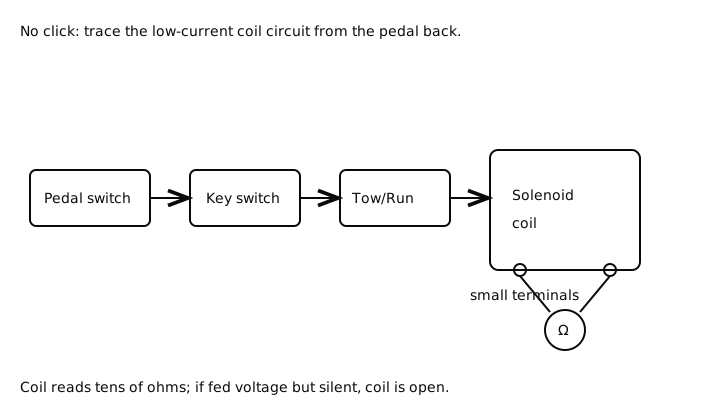
The throttle input or pedal micro-switch
At the bottom of pedal travel a micro-switch or throttle input tells the system that drive is wanted, and on many carts it is this signal that closes the solenoid. If the micro-switch never makes, or the throttle sensor never signals, the coil is never energized and the solenoid stays silent. On Club Car models with an MCOR throttle sensor, and E-Z-GO models with an inductive throttle sensor, this is a common no-click cause.
3Check the switch or sensor as the pedal moves
With the meter across the pedal micro-switch, or on the throttle sensor output where fitted, watch for the signal to change as you press the pedal.
ExpectedA working micro-switch closes with an audible click and shows continuity at the bottom of pedal travel. A sensor should sweep smoothly. No change at all means the switch or sensor is not signaling.
Reseat the connector first, since a shaken-loose plug is a common no-cost fix. A micro-switch that never makes can often be adjusted or replaced; a faulty throttle sensor is covered in the MCOR and inductive sensor guides.
A failed key switch
The key switch feeds the coil circuit as well as the dash, and on some wiring it can power the lights while failing to pass the feed the coil needs. Worn contacts and loose spade terminals on the back of the switch are the usual causes, and an intermittent no-click that comes and goes as you jiggle the key points straight at it.
4Back-probe the key switch output
Set the meter to DC volts, back-probe the key switch output against pack negative and turn the key on.
ExpectedBattery voltage in but none out with the key on means the switch or its terminals have failed. Voltage passing through clears the key switch and sends you further down the coil circuit.
Loose spade terminals often just need cleaning and reseating; a worn switch needs replacing, as the key switch guide covers.
The Tow/Run switch in Tow or failed
The Tow/Run switch disconnects the controller and, on many carts, breaks the coil circuit, so a switch left in Tow gives no click at all. Beyond the wrong position, the switch itself can fail or its contacts corrode, and on some models a diode in the circuit can fail and break the feed.
5Set to Run and test the switch output
Set the switch firmly to Run, then back-probe its output with the meter to confirm voltage passes when it should.
ExpectedNo output in the Run position means the switch or its wiring has failed. Correct output confirms the switch and moves the fault along the circuit; the reset procedures guide covers the Tow/Run reset on Club Car models with an onboard computer.
Clean and reseat the connections first. A failed switch is replaced as covered in the Tow/Run switch guide, and it is worth checking any inline diode on models that use one.
A broken wire or corroded plug in the coil circuit
The coil circuit is a low-current path through several plugs and switches, and any break in it, a corroded connector, a chafed wire or a loose spade, stops the coil energizing. Because the current is small, a partly corroded connection that would pass drive current can still fail to carry the coil feed, which makes these breaks easy to miss.
6Check for coil supply voltage at the small terminal
With the pedal pressed and the wheels chocked, read DC volts at the solenoid's small terminal that should be fed, against pack negative.
ExpectedCoil supply voltage at the small terminal when the pedal is pressed means the circuit is intact and the coil itself is the suspect. No voltage there means the break is upstream, in the switches, plugs or wiring.
Work back from the solenoid toward the pedal, checking each plug and switch in turn, cleaning and reseating as you go. A single corroded connector is a common and satisfying find.
An open solenoid coil
The coil itself can fail open, and then the solenoid will not click even when the circuit feeding it is sound. It is less common than a fault in the feed circuit, which is why it sits lower here, but it is quick to confirm once you have voltage arriving at the small terminal.
7Measure the coil across the small terminals
With the pack isolated, disconnect the two small coil wires and read resistance across the small terminals.
ExpectedA good coil reads in the tens of ohms, with the exact value set by its voltage rating. An open reading means the coil has failed and the solenoid needs replacing.
If the coil is open, replace the solenoid; the full measurement and replacement are in Testing and replacing a solenoid. If the coil is healthy but never sees voltage, the fault is back up the feed circuit you have just traced.
High pedal disable or an interlock on models with one
Some carts use a high pedal disable that refuses drive if the pedal is already pressed at key-on, and others have seat or brake interlocks in the coil circuit. These are safety features, not faults, but a stuck pedal switch or a failed interlock can hold the coil circuit open and give a permanent no-click that looks like a breakdown.
8Release the pedal at key-on and check the interlock
Switch on with your foot off the pedal, then press it, and check any seat or brake interlock switch for correct operation.
ExpectedDrive returning when you start with the pedal released confirms high pedal disable was doing its job. A no-click that survives this points at a stuck pedal switch or a failed interlock in the circuit.
On E-Z-GO RXV and similar models with high pedal disable, always start with the pedal up. A genuinely stuck switch or interlock needs inspecting and, if faulty, replacing.
When to get professional help
Get professional help if you have traced the coil circuit and cannot find the break, if the throttle sensor or an interlock is faulty and you would rather not replace it, or if the fault sits in wiring you are not confident tracing. A no-click is almost always a small, cheap component in the coil circuit, and finding which one in order costs far less than replacing the solenoid, the switch and the sensor in turn.
Common questions
My solenoid doesn't click at all. Where do I start?
No click means the coil circuit is not completing, so trace it from the pedal back: the throttle input or pedal micro-switch, the key switch, the Tow/Run switch, then the coil itself. Confirm the Tow/Run switch is in Run and, on models with high pedal disable, start with your foot off the pedal.
Is a solenoid that won't click always a failed solenoid?
No, and it usually is not. Most no-click faults are in the low-current circuit feeding the coil: a micro-switch that never makes, a failed key switch, a corroded plug or a broken wire. Check for coil supply voltage at the small terminal before condemning the solenoid itself.
What resistance should the solenoid coil read?
A healthy coil reads in the tens of ohms, with the exact figure set by its voltage rating, so check your model's specification. An open reading means the coil has failed. A coil that reads correctly but never sees voltage points the fault back up the feed circuit.
Why does my cart have power but no click on the pedal?
Power at the dash only proves the key switch feeds the lights; the coil circuit is a separate low-current path that can still be broken. A switch, plug or wire anywhere between the pedal and the coil can stop the click while the lights stay on.
Could a safety switch be stopping the click?
Yes. On models with high pedal disable, pressing the pedal before switching on blocks drive on purpose, so start with your foot up. Seat and brake interlocks in the coil circuit can also hold it open if a switch sticks or fails.
Is it safe to probe the coil circuit myself?
Yes, with care. Chock the wheels and stay clear of the path of travel, because the cart will move the moment the circuit completes. Keep tools and jewelry away from the large solenoid terminals, and isolate the pack for any work past meter probing.
Did this fix it?
Every guide is written from manufacturer service documentation and workshop practice, then reviewed before publication. Read how we write and review our repair guides.