Golf cart running slow: causes and fixes
Written by the Hawke Electric Vehicles Service Team
Quick answer
A golf cart that is slower than usual is most often held back by a tired battery pack that cannot hold voltage under load, by brakes that are dragging, or by soft tires, and less often by a worn throttle, controller heat or a speed setting. Work down the causes in order of likelihood: load-test the pack first, then check for a warm hub and the correct tire pressures before touching anything electronic.
Tools needed
- Digital multimeter
- Air pressure gauge
- Insulated wrenches
- Safety glasses
- Work light
Confirm the symptom
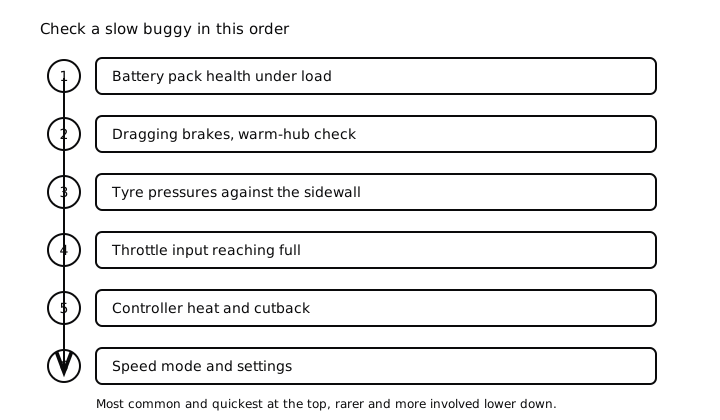
This master guide is for a cart that still drives but is generally slower than it used to be, on the flat as well as on hills, and covers the causes in the order worth checking them. Because slowness has several common causes, the fastest route to the answer is to work down a ranked list rather than guessing, and the diagram below sets that order out.
If the cart is slow only when climbing but has normal speed on the flat, the focused guide is Slow uphill only. If the top speed dropped suddenly rather than tailing off, read Top speed dropped suddenly, which points more at a setting or a sensor than at gradual wear. If the cart covers less distance than before but is not slower, that is a range question covered in Range shorter than before.
1Establish how slow, and where
Drive a known flat stretch and a gentle hill and note whether the cart is down everywhere or only under load, and whether it got slower gradually or overnight.
ExpectedA gradual loss everywhere points at the pack, brakes or tires; a sudden loss points at a setting, a sensor or a fault code, which is the top-speed-dropped guide
What causes it
| Cause | How common | How to confirm | Fix |
|---|---|---|---|
| Battery pack that cannot hold voltage under load | very common | Load-test the whole pack and each battery while the cart is held on the brake | How to test golf cart batteries with a multimeter |
| Dragging brakes | very common | Raised, a dragging wheel is hard to spin; after a drive its hub runs hot | How to adjust golf cart drum brakes |
| Soft tires | common | Check each tire against the pressure on its sidewall with a gauge | |
| Worn throttle input not reaching full demand | common | Sweep the throttle signal and confirm it reaches its full value at full pedal | |
| Controller heat and cutback | occasional | Speed falls only after sustained running or a climb and recovers after a cool-down | |
| Speed mode or a limited setting | occasional | Check the speed mode switch and any programmed limit for the model |
A battery pack that cannot hold voltage under load
The most common reason a cart slows down over time is that the pack has aged and can no longer hold its voltage when current is drawn. A pack can read close to full at rest and still sag heavily under load, and because motor speed depends on the voltage the controller can deliver, that sag shows up directly as reduced speed. This is why a rested voltage check alone is misleading and a load test is the real answer.
2Load-test the pack and each battery
With a helper holding the cart against the brake and the pedal pressed to load the pack, read the whole pack and then each battery in turn.
ExpectedA healthy pack holds up; each good battery sags evenly and stays above roughly 1.75 V per cell, meaning about 5.25 V on a 6 V battery, 7 V on an 8 V and 10.5 V on a 12 V. One unit that plunges far below the rest has failed and is capping the whole pack
If one battery collapses, Finding the one bad battery in a pack confirms it before you buy; if the whole pack sags evenly it is simply worn, as Battery lifespan and replacement signs describes. Make sure the pack is fully charged and the electrolyte covers the plates first, because a part-charged or dry pack sags for reasons that are quick to correct. Range loss and batteries draining fast covers the pack-condition picture in full.
Dragging brakes
A brake that is dragging holds the cart back the whole time it is moving, and because the motor is fighting that drag it delivers less speed and heats up faster. Dragging brakes are one of the most common and most overlooked causes of a slow cart, and the warm-hub check finds them in minutes.
3Spin each wheel and feel the hubs
With the cart safely raised on stands, spin each wheel by hand and compare how freely they turn, then after a short drive carefully feel each hub or drum.
ExpectedA free wheel spins several turns and coasts; a dragging wheel stops quickly and its hub runs noticeably hotter than the others after a drive, which confirms the drag
A dragging drum brake is usually out of adjustment or has a seized or sticky mechanism, a corroded cable or a weak return spring. Drum brake adjustment step by step covers backing the adjustment off correctly, and Brakes dragging cart feels held back covers the seized-mechanism and cable causes. Fixing a drag often restores noticeable speed on its own.
Soft tires
Underinflated tires increase rolling resistance and slightly reduce the rolling diameter, both of which cost speed and range, and they are the quickest thing on the list to check and put right. Tires lose pressure slowly over time, so this is easy to miss.
4Check every tire against its sidewall figure
With a gauge, measure each tire cold and compare it with the pressure marked on that tire's sidewall.
ExpectedGolf cart tires typically run somewhere in the region of 15 to 25 psi depending on the tire, but the figure that matters is the one on the sidewall or in the manual; set each tire to that
Inflate any soft tire to its marked pressure and recheck for a slow leak if one keeps going down. Correct tire pressures covers the detail, and Fixing a flat or slow puncture covers a tire that will not hold air. Keeping the tires correct is part of routine care and pays back in both speed and range.
A worn throttle input not reaching full demand
If a worn throttle input no longer reaches its full value at full pedal, the controller never sees a full request and the cart feels down on top speed even though nothing dramatic has failed. This is subtler than the jerky-acceleration case, where the fault is a step in the travel; here the fault is that the top of the range is missing.
5Sweep the throttle to its full value
With the drive safely disabled or a wheel raised, back-probe the throttle signal and have a helper press the pedal fully while you watch the reading reach its top value.
ExpectedA good input rises smoothly to its full value at full pedal; a signal that stops short of full, or has a flat spot near the top, points at a worn sensor or a linkage not reaching full travel
Adjust the linkage so the pedal drives the sensor through its full arc, or replace a worn sensor, using the throttle guides for the model such as Club Car MCOR faults and Potentiometer wear on older throttles. A linkage that is simply not reaching full travel is a cheap fix.
Controller heat and cutback
A controller that is running hot reduces power to protect itself, so the cart is fine when cool and slows after sustained running or a climb, recovering once it cools. If the earlier causes are all sound, heat is worth considering, and it is usually a symptom of the drive working too hard because of one of the causes above rather than a controller fault on its own.
6See whether the loss follows heat
Note whether the cart is at normal speed from cold and only slows after several minutes of running or a climb, then recovers after standing.
ExpectedNormal speed cold, falling only after sustained load and recovering after a cool-down, fits thermal cutback rather than steady wear
Address the reasons for the extra heat, dragging brakes, soft tires and a tired pack, before looking at the controller itself. Controller overheating and thermal cutback covers the airflow and cooling side, and Limp mode causes and clearing covers a controller that stays in reduced power after the event.
A speed mode or a limited setting
Many carts have a speed mode switch or a programmed speed limit, and a cart that is suddenly and consistently capped, rather than gradually slower, may simply be in a lower mode or have had a setting changed. This is worth a quick check before deeper diagnosis, especially if the change was sudden.
Check the speed mode switch position and any dealer-set limit for the model. Speed modes and settings by brand explains where these live and how they behave, and if the top speed dropped overnight rather than tailing off, Top speed dropped suddenly is the guide that pairs with a setting or a sensor fault.
When to get professional help
Bring in a technician if the pack fails its load test and you are not set up to replace batteries, if a brake will not free off with adjustment, if the throttle input will not reach full and needs a new sensor you are not confident fitting, or if a fault code or a locked setting points at the controller. Working down the ranked list settles most slow-cart cases at home, and calling early saves guessing at expensive parts.
Common questions
Why is my cart slow even with a full charge?
A pack can show full at rest and still sag under load once it is worn, and motor speed follows the voltage the controller can deliver, so a tired pack is slow despite a full reading. Load-test the pack and each battery; that is the check that a rested voltage cannot give you.
How do I tell if a brake is dragging?
Raise the cart safely on stands and spin each wheel: a free wheel coasts for several turns while a dragging one stops quickly. After a short drive, a dragging brake also leaves its hub noticeably hotter than the others. Both are quick, reliable indicators.
What pressure should golf cart tires be?
It varies by tire, typically somewhere in the region of 15 to 25 psi, but the figure that matters is printed on the tire sidewall or given in the manual. Set each tire to its own marked pressure rather than a generic number, and check them cold.
Can dragging brakes really slow the cart that much?
Yes. A brake dragging on even one wheel forces the motor to fight it constantly, cutting speed and range and generating heat that can bring on controller cutback. Freeing a dragging brake often restores a clear chunk of lost speed by itself.
Should I check the pack or the settings first?
Check the pack, brakes and tires first, because they are the most common causes and the quickest to test. Speed modes and controller settings sit lower on the list and are worth checking mainly when the loss was sudden rather than gradual.
Did this fix it?
Every guide is written from manufacturer service documentation and workshop practice, then reviewed before publication. Read how we write and review our repair guides.