How to bench-test a golf cart motor
Written by the Hawke Electric Vehicles Service Team
Quick answer
Bench-testing a golf cart motor comes down to checking the windings for continuity, checking for a short from the windings to the motor case, and running a short spin test off a battery to confirm the motor turns freely and smoothly. It is a moderate job of 30 to 60 minutes with a multimeter, a battery and jumper cables, and it tells you whether the motor or the controller is at fault before you spend on either.
Tools needed
- Digital multimeter
- 12 volt battery for the spin test
- Insulated jumper leads with clamps
- Socket and wrench set
- Safety glasses
- Insulated gloves
- Clamp or vice to secure the motor
What this fixes
A bench test answers a single question: is the motor itself bad, or is the trouble in the controller, wiring or solenoid feeding it. Reach for it when a cart is slow, cuts out under load, will not move, runs rough or noisy, or trips the controller. A healthy motor points you back at the controller and wiring; a faulty motor saves you from bolting on a new controller that will not fix a thing. This procedure tests the windings and bearings; it does not rebuild a motor, which the brush and motor rebuild work cover.
Tools and parts
Parts
- No parts are needed to test; a spin-test battery and cables are tools
Grab a multimeter set to a low ohms range, a 12 volt battery for the spin test, insulated jumper cables with clamps, a socket and wrench set to free the motor terminals and mounts, safety glasses, insulated gloves and a clamp or vise to hold the motor still. This is a moderate job of 30 to 60 minutes. You can run the meter checks with the motor still on the cart as long as you disconnect its cables, but the spin test is safest with the motor out and clamped down.
How to do it
1Isolate and disconnect the motor
With the pack isolated and the capacitors bled down, label and disconnect the motor cables. From your manual, note which terminals are the armature pair and which are the field pair, since the markings differ from motor to motor.
ExpectedThe motor is de-energized, the cables are labeled, and you know which terminals are the armature and which are the field
2Test the armature winding for continuity
Set the meter to a low ohms range and measure across the two armature terminals while you slowly turn the shaft by hand, so the brushes ride across the commutator segments.
ExpectedA steady very low reading, near zero ohms, that holds roughly constant as the shaft turns; an open reading or wild jumps point to worn brushes, a dirty commutator or a broken winding
3Test the field winding for continuity
Measure across the two field terminals with the meter on the same low ohms range.
ExpectedA very low reading, near zero ohms; an open circuit means a broken field winding and a dead motor
4Check for a short to the case
Set the meter to its highest resistance range, hold one lead on bare metal on the motor case and touch each motor terminal in turn with the other.
ExpectedNo continuity and a very high or open reading from every terminal to the case; any low reading means a winding is shorting to the case and the motor is done
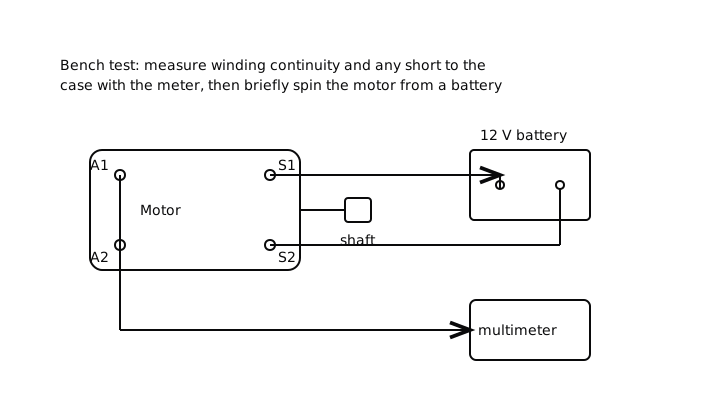
5Spin-test the motor off a battery
Clamp the motor down, connect the field terminals to the battery, then briefly tap the armature terminals to the battery for a second or two. Stay clear of the shaft. Swapping the armature connection reverses the direction.
ExpectedThe motor spins up right away and smoothly for the brief moment power is applied; a motor that will not turn, turns slowly, sparks heavily at the brushes or screeches has a fault
6Check the bearings and free rotation
With power off, spin the shaft by hand and feel and listen. Then push and pull the shaft in and out and try to rock it.
ExpectedThe shaft turns freely and quietly and coasts to a stop; grinding, roughness, notchiness or noticeable play in the shaft means worn bearings
Check it worked
7Weigh the results together
Put the readings side by side: winding continuity, no short to the case, a clean smooth spin and free quiet bearings.
ExpectedAll four good means a healthy motor, so move on to the controller, solenoid and wiring; any failed check names the motor as the fault and shows whether it is a brush, winding or bearing problem
When to get professional help
Get a professional if the tests reveal a short to the case, an open winding, heavy sparking or a bad bearing, since those call for a motor rebuild or replacement rather than a driveway fix. It is also worth a pro if every motor test passes but the cart still will not run, because the fault then lives in the controller, solenoid, throttle or wiring, and a technician can load-test the whole drive circuit. A bench test narrows the fault down; acting on it often takes specialized tools.
Common questions
Can I test a golf cart motor without removing it?
You can run the multimeter checks in place as long as you disconnect the motor cables first, so the pack cannot back-feed the meter. The spin test is another matter: the motor lurches when power hits it, so it is safest with the motor out and clamped to a bench or held in a vise.
What should the winding resistance read?
Both the armature and field windings should read a very low resistance, near zero ohms, because they are heavy copper windings. The exact figures are too small for a basic meter to show precisely, so read near-zero as healthy and an open or high reading as a broken winding.
How do I tell a motor fault from a controller fault?
Bench-test the motor. If the windings have continuity, there is no short to the case, and the motor spins cleanly on a battery, the motor is good and the fault sits in the controller, solenoid, throttle or wiring. A failed motor test points the other way.
Is it safe to run a motor off a 12 volt battery?
For a brief spin test, yes, with care. A 12 volt supply turns most cart motors slowly enough to judge whether they run, without the speed of the full pack. Clamp the motor, stay clear of the shaft, and apply power for only a second or two so a shorted motor cannot overheat.
Why does my motor spin but the cart still will not move?
A motor that passes on the bench but does nothing on the cart points to what sits between it and the wheels or the controller: a failed solenoid, a controller fault, a throttle sensor, or a mechanical problem in the transaxle. The bench test has done its job by clearing the motor.
What does heavy sparking at the brushes mean?
A little sparking is normal, but heavy, ringing sparking during the spin test points to worn brushes, a dirty or scored commutator, or a winding fault. Check the brushes and commutator first, since those are serviceable; a winding fault means a rebuild.
Did this fix it?
Every guide is written from manufacturer service documentation and workshop practice, then reviewed before publication. Read how we write and review our repair guides.