Golf cart not charging: causes and fixes
Written by the Hawke Electric Vehicles Service Team
Quick answer
When a golf cart will not charge at all, the usual suspects are a pack too deeply discharged for the charger to detect, a dead wall outlet, or a blown charger fuse. The first check is pack voltage at the battery terminals with a multimeter. A reading far below nominal usually means the charger is refusing to start, not that it has failed.
Tools needed
- Digital multimeter
- Safety glasses
- Insulated gloves
- Work light
Parts needed
- Replacement charger fuse, rating as printed on the charger label
Confirm the symptom
You are in the right place if the charger does absolutely nothing when you plug it into the cart: no lights, no fan noise, no hum, no click, and the state-of-charge meter never moves. Complete silence narrows the fault list considerably, because a charger that starts and then quits fails in a different way.
A charger that clicks once, or cycles on and off with a click-clack sound, belongs in the guide Charger clicks but won't charge. A charger that stays dark even on a known-good outlet with the cart disconnected has a supply-side problem; see Charger has no lights or power. And if charging completes but the pack runs down fast afterward, the batteries are accepting charge and the better guide is Golf cart batteries dying quickly.
1Prove the outlet first
Move the charger to an outlet that is currently powering something else, then hook it to the cart. This clears the single most common non-fault, a dead outlet or tripped breaker, before any meter work.
ExpectedAny sign of life, a light, a fan, a click, means the charger has power and the problem sits between the charger and the pack
2Watch pack voltage with the charger connected
Set a multimeter to DC volts, read across the pack's outermost terminals, connect the charger and watch for a minute.
ExpectedA pack that is charging climbs a volt or more within a minute; a reading that never moves confirms no current is flowing
What causes it
| Cause | How common | How to confirm | Fix |
|---|---|---|---|
| Pack voltage below the charger's wake threshold | very common | Measure pack voltage at the battery terminals and compare with nominal | How to test golf cart batteries with a multimeter |
| Dead outlet or tripped breaker or GFCI | very common | Run another appliance from the same outlet; check the breaker panel and GFCI reset | |
| Blown charger fuse | common | Locate the fuse and continuity-test it with a multimeter | |
| Damaged charge cord, plug or receptacle | common | Inspect the pins for burning; compare voltage at the plug pins with the terminals | |
| Charge control fault on Club Car models with an OBC | occasional | Charger works on another vehicle; pack voltage healthy; relay never signaled | |
| Failed charger | occasional | Rule out everything above, then try the charger on a known-good vehicle |
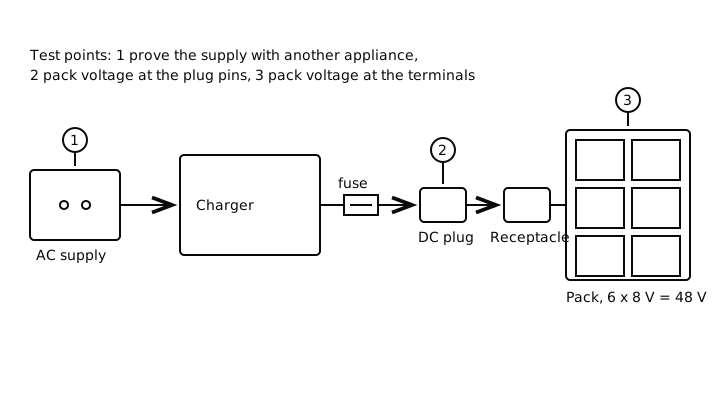
Pack voltage below the charger wake threshold
An automatic golf cart charger checks for battery voltage before it will deliver current. Run the pack all the way down, or let it self-discharge through months of storage, and the voltage at the plug can fall below the minimum the charger needs to wake up. The result is a charger that does nothing, which looks exactly like a dead charger but is not one. Wake thresholds differ by charger family: a lot of 36 volt chargers need to see somewhere above roughly 20 to 28 volts, and a lot of 48 volt chargers somewhere above roughly 28 to 38 volts. Your charger manual or label has the real number, so read these as working ranges.
3Read the pack at the battery terminals
With the charger unplugged, set the meter to DC volts and measure across the whole pack, most positive post to most negative post.
ExpectedRested and full, a 36 V pack reads about 38.2 V and sits near 36.5 V at half charge; a 48 V pack reads about 50.9 V full and near 48.7 V at half charge. A pack far below nominal, say under 30 V on a 48 V system, is usually under the charger's wake threshold
4Read each battery on its own
Measure across the posts of every battery and write the values down in order. The multimeter testing guide has the full rested voltage tables and method.
ExpectedRested at full charge, a 6 V battery reads 6.3 to 6.4 V, an 8 V battery 8.4 to 8.5 V, a 12 V battery 12.6 to 12.7 V. Any battery a volt or more under its siblings is probably a failed unit pulling the pack down; see the guide on finding the one bad battery
Recovery depends on how deep the discharge is. A pack that is simply flat can be brought back by raising its voltage past the wake threshold: charge each battery individually with a small charger of the matching voltage, supervised and in a ventilated space, until the pack total clears the threshold and the automatic charger takes over. First, though, confirm the electrolyte covers the plates in every cell and top up with distilled water where it does not; the watering guide explains the timing. A battery that will not come up, or sinks right back down, has failed internally and no amount of recovery charging will hold.
No power at the wall outlet
A dead outlet is the most boring cause on the list and one of the most frequent. Garage outlets often sit downstream of a GFCI that trips without anyone noticing, and extension cords add failure points of their own.
5Test the outlet with another appliance
Plug a lamp or similar load into the exact outlet the charger uses, including any extension cord in the chain. If it is dead, press the reset button on any GFCI outlet on the circuit and check the breaker panel, resetting a tripped breaker once.
ExpectedThe appliance runs; if it does not, the supply circuit is the problem, not the charger or the cart
A breaker or GFCI that trips again the moment the charger is plugged in is telling you the charger has an internal fault. Stop resetting and have the charger repaired or replaced.
A blown charger fuse
Most cart chargers carry at least one fuse, in a spot that varies by model: an external holder on the case, an inline fuse on the DC output cord, or blade fuses on the internal board. Limit yourself to fuses you can reach without opening the case.
6Continuity-test any accessible fuse
Unplug the charger from the wall and the cart, pull the fuse from its holder and test it on the meter's continuity or resistance range.
ExpectedA good fuse beeps on continuity or reads near 0 ohms; an open circuit means it has blown
Fit only the type and rating printed on the charger label or fuse holder. If the replacement blows right away, never step up to a bigger fuse; excess current draw downstream is the real fault and the charger needs professional service.
A damaged charge cord, plug or receptacle
The DC plug and the receptacle on the cart carry the full charge current, which makes worn or burned contacts a frequent failure. Look for pitted or discolored pins, melted plastic, or a plug that rocks loosely in the receptacle.
7Compare receptacle-pin voltage with pack voltage
With the charger unplugged from the wall, measure DC volts across the pins inside the cart's receptacle, then across the pack terminals.
ExpectedThe readings should agree within about 0.1 to 0.2 V. Full voltage at the pack but little or none at the receptacle pins means a break in the receptacle wiring, its fuse where one is fitted, or the receptacle itself
Burned receptacle contacts deteriorate fast, because resistance builds heat and heat builds more resistance. The charger receptacle guide covers replacement when the damage is confirmed.
Charge control faults on Club Car models
Club Car models with an onboard computer route the charge circuit through the OBC, and the charger starts only when the OBC completes that circuit. When the OBC fails to signal, a good charger and a good pack still sit there doing nothing. The widely used reset: flip the Tow/Run switch to Tow, disconnect the main negative battery cable for a few minutes, reconnect, switch back to Run, and plug the charger in again.
If the reset changes nothing and the same charger runs fine on another vehicle, hand the OBC diagnosis to a professional; the fault may live in the OBC, its wiring, or the relay it controls.
A failed charger
Chargers do fail, but less often than everything above, which is why this cause sits last. One trap to avoid: an automatic charger produces no output until it senses a battery, so bench-testing the DC plug and reading 0 volts proves nothing about whether the charger works.
8Try the charger on a known-good cart
If another cart with the same pack voltage and plug type is available, connect the suspect charger to it.
ExpectedCharger starts normally on the other cart: your charger is fine and the fault is on your vehicle. Silent on both: the charger has failed
Leave the case closed either way. Charger capacitors hold enough energy to deliver a serious shock long after unplugging, and internal repair belongs with a technician.
When to get professional help
Bring in a professional if the pack sits below the wake threshold and a supervised recovery charge is outside your comfort zone, if a fresh fuse blows immediately, if the receptacle contacts show burning, if a Club Car OBC reset does not restore charging, or if everything points at the charger internals. Each of these is a quick diagnosis with the right equipment, and replacing parts on a guess, charger first, then batteries, is the expensive way to get the same answer.
Common questions
What voltage does my pack need before the charger will start?
It depends on the charger family: many 36 V chargers want the pack above roughly 20 to 28 V, and many 48 V chargers above roughly 28 to 38 V. Your charger manual states the exact wake threshold. Any pack near its nominal voltage will be detected.
What should a fully charged pack read after resting?
Around 38.2 V for a 36 V pack and around 50.9 V for a 48 V pack, measured a few hours after the charger is disconnected. Per battery that works out to 6.3 to 6.4 V for 6 V units, 8.4 to 8.5 V for 8 V units and 12.6 to 12.7 V for 12 V units.
Can I wake a dead pack with a regular automotive charger?
Battery by battery, yes, with care. A basic 12 V charger matches 12 V batteries; 6 V and 8 V units need a charger with the matching setting. Supervise the charge in a ventilated space, lift the pack just past the wake threshold, then let the cart's own charger finish.
How long does a full charge normally take?
Figure 6 to 10 hours for a deeply discharged lead-acid pack on its matched automatic charger. Pack size, charger output and battery age all move that number, so a cycle inside that band is normal, and a cycle that ends in under an hour deserves investigation.
Why is there no click at all from my charger?
Total silence usually means the charger has no supply, its fuse is open, or the pack is under the wake voltage so the charger never attempts a start. A click followed by nothing is a different failure path, covered in the charger clicking guide.
Will buying a new charger fix my cart?
Only if the charger is genuinely the fault, and statistically it is the least likely of the common causes. Measure the pack, prove the outlet, check the fuse and inspect the receptacle first; most no-charge cases resolve on the vehicle side.
Did this fix it?
Every guide is written from manufacturer service documentation and workshop practice, then reviewed before publication. Read how we write and review our repair guides.