Golf cart charger not working: no power or lights
Written by the Hawke Electric Vehicles Service Team
Quick answer
A golf cart charger that shows no lights and no signs of life is usually on a dead outlet, has a blown fuse, or has a damaged power cord. Before you write it off, connect it to the cart, because many automatic chargers stay dark until they detect the pack. Prove the outlet with another appliance, then check the charger's fuse.
Tools needed
- Digital multimeter
- Safety glasses
- Work light
Parts needed
- Replacement charger fuse, rating as printed on the charger label
- Replacement power cord if a detachable type
Confirm the symptom
You are in the right place if the charger looks completely dead: no lights on the case, no fan, no hum and no warmth, connected to the cart or not. That points to the supply side of the charger, the outlet, the cord, the fuse and the charger's own power section, rather than anything in the battery pack.
Clear one trap first. Many automatic chargers show no lights on the bench and only wake when they sense battery voltage at the output, so a charger that is dark while unplugged from the cart may be perfectly fine. If the charger clicks, hums or lights once it is connected to the cart but still will not charge, you are on the wrong guide; read Golf cart charger clicks but won't charge. If it lights and charges but the pack then runs down fast, see Golf cart batteries dying quickly.
1Connect the charger to the cart before judging it
Plug the charger into an outlet you know works, connect it to the cart and watch for any light, fan or hum that was missing on the bench.
ExpectedThe charger comes to life once it sees the pack: it was working normally and the earlier silence was the auto-detect feature, not a fault
2Prove the outlet with another appliance
Plug a lamp or similar load into the exact outlet the charger uses, including any extension cord in the chain.
ExpectedThe appliance runs; if it is dead too, the supply circuit is the fault, not the charger
What causes it
| Cause | How common | How to confirm | Fix |
|---|---|---|---|
| Dead outlet or tripped breaker or GFCI | very common | Run another appliance from the same outlet; check the panel and GFCI reset | |
| Blown charger fuse | very common | Locate the fuse and continuity-test it with a multimeter | How to test golf cart batteries with a multimeter |
| Damaged power cord or plug | common | Inspect the cord and plug; swap in a known-good cord where detachable | |
| Charger not woken because it only lights on a connected pack | common | Connect the charger to the cart and watch for lights or a hum | |
| Failed internal power section on the charger board | occasional | Outlet, fuse and cord all proven good, yet the charger stays dead |
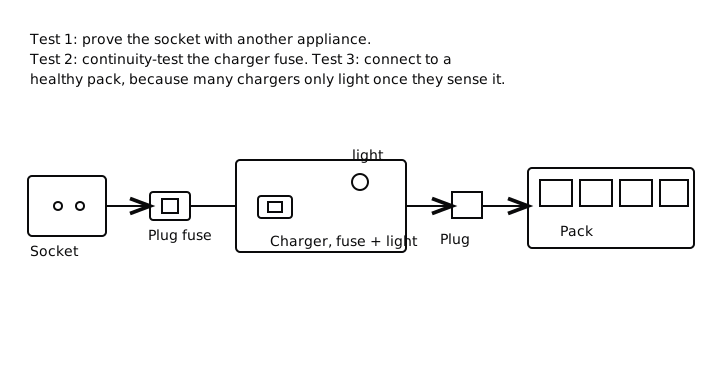
A dead outlet or tripped breaker
A dead outlet is the most frequent reason a charger looks broken and one of the easiest to miss. Garage outlets often sit downstream of a GFCI that trips without anyone noticing, and extension cords and power strips add their own contacts to fail. Rule this out first because it costs nothing and needs no tools.
3Reset the circuit and retest
If the test appliance is dead, press the reset on any GFCI outlet on the circuit, check the breaker panel and reset a tripped breaker once, then plug the appliance back in.
ExpectedThe appliance and then the charger run after the reset: the circuit had tripped. If the breaker or GFCI trips again the instant the charger is plugged in, the charger has an internal fault and needs repair, not repeated resetting
Do not sit resetting a breaker that keeps tripping under the charger. A charger that trips the circuit is telling you something inside it has failed, and forcing power back to it lets the fault get worse.
A blown charger fuse
Most cart chargers carry at least one fuse, and a blown fuse is a very common reason for a completely dead charger. The spot varies by model: an external holder on the case, an inline fuse on a cord, or blade fuses on the internal board. Only test fuses you can reach without opening the case.
4Continuity-test any accessible fuse
Unplug the charger from the wall and the cart, pull the fuse from its holder and test it on the meter's continuity or resistance range. The multimeter testing guide shows the method if continuity mode is new to you.
ExpectedA good fuse beeps on continuity or reads near 0 ohms; an open reading means it has blown and is why the charger is dead
Fit only the type and rating printed on the charger label or the fuse holder. If the replacement blows right away, never step up to a bigger fuse; something inside the charger is drawing too much current and the unit needs professional service.
A damaged power cord or plug
The power cord takes a lot of handling, so a cracked plug or a conductor pulled loose at the strain relief can leave the charger with no supply while the outlet is fine. On chargers with a detachable cord, the whole cord can be swapped for a known-good one to test it in seconds.
5Inspect and swap the cord
Look along the whole cord for cuts, kinks or heat marks, flex it gently near each end, then fit a known-good detachable cord if the charger uses one.
ExpectedThe charger comes alive with a known-good cord: the original cord was the fault. No change means the fault is elsewhere
Do not tape over a damaged cord and keep using it. A cord with broken insulation or a stressed conductor is a shock and fire risk, and a replacement cord is inexpensive next to the alternative.
The charger only lights on a connected pack
This is a non-fault worth spelling out, because it sends healthy chargers to the trash. An automatic charger is built to deliver nothing, and often to show nothing, until it senses battery voltage at the output. On the bench it looks dead, and reading 0 volts at its DC plug proves nothing. The charger is only meant to respond when connected to a pack inside its wake range.
6Wake the charger on a healthy pack
Plug the charger into a working outlet and connect it to a cart whose pack is at or near nominal voltage, about 38.2 V rested on a 36 V system or about 50.9 V on a 48 V system.
ExpectedThe charger lights and starts charging: it was fine all along and the auto-detect feature was hiding it. Nothing at all on a healthy pack moves the fault to the outlet, the fuse, the cord or the charger board
If the pack itself is very flat, the charger may still stay dark because the pack is below its wake range. That is a different fault, covered in Golf cart not charging, where the fix is a supervised recovery charge to raise the pack back over the threshold.
A failed internal power section
Only after the outlet, the fuse and the cord are all proven good, and the charger stays dead on a healthy pack, does a failed charger become the likely answer. A dead internal power section is less common than any cause above, which is why it lands last.
Do not open the case to dig further. Charger capacitors store enough energy to give a serious shock well after the cord is pulled, and board-level repair or replacement is a technician job. The sensible test now is a known-good charger of the same voltage and plug type: if it wakes and charges your cart normally, your original charger has failed.
When to get professional help
Bring in a professional if a replacement charger fuse blows immediately, if the circuit trips every time the charger is plugged in, or if the outlet, fuse and cord are all sound yet the charger stays dead on a healthy pack. These point inside the charger, where the capacitors make DIY work unsafe, and a technician can confirm the charger against a known-good pack before you spend on a replacement.
Common questions
Why are there no lights on my charger at all?
The three usual reasons are a dead outlet, a blown fuse in the charger, and a damaged power cord. There is also a common non-fault: many automatic chargers stay dark until they are connected to a pack and sense battery voltage, so always test the charger connected to the cart before judging it.
Should the charger light up before I plug it into the cart?
Often not. Many automatic chargers show nothing on the bench and only wake once they detect the pack at the output. A charger that is dark while unplugged from the cart but lights and charges once connected is working exactly as designed.
How do I check the charger fuse?
Unplug the charger from the wall and the cart, pull any fuse you can reach without opening the case, and test it on the meter's continuity range. A good fuse beeps or reads near 0 ohms; an open reading means it blew. Replace only with the same type and rating on the label.
What if the new fuse blows right away?
Stop and do not fit a bigger fuse. A replacement that blows at once means something inside the charger is pulling too much current, and running it on an oversized fuse is a fire and shock risk. The charger needs professional service.
Can I open the charger to look inside?
No. The capacitors inside hold enough energy to give a serious shock long after the charger is unplugged, so opening the case is not a DIY job. Confirm the outlet, fuse and cord from the outside, then hand the charger to a technician if it is still dead.
Is my charger dead if it reads 0 volts on the bench?
Not necessarily. An automatic charger produces no output until it senses a battery, so 0 volts at the DC plug on the bench is normal. Judge the charger only when it is connected to a pack that sits within its wake range.
Did this fix it?
Every guide is written from manufacturer service documentation and workshop practice, then reviewed before publication. Read how we write and review our repair guides.