Golf cart charger clicks but won't charge
Written by the Hawke Electric Vehicles Service Team
Quick answer
When a golf cart charger clicks once, or repeats a click-clack, and then charges nothing, it has usually sensed the pack, attempted to connect and pulled straight back. The common causes are pack voltage sitting on the charger's handshake threshold, a single failed battery collapsing under the first current, or a poor connection at the receptacle. Begin by reading the whole pack, then every battery, at the terminals.
Tools needed
- Digital multimeter
- Safety glasses
- Insulated gloves
- Work light
Confirm the symptom
You are in the right place if the charger gives a relay click, a single clack, or a repeating click-clack, and then charges nothing: the ammeter or charge light never settles into a steady state and pack voltage does not climb. The click is useful information, because it proves the charger has power and is trying to connect to the pack. That already clears a dead outlet and a blown line fuse, which are what silence points to.
A charger that is completely silent, with no click, no fan and no lights, belongs in the guide Golf cart not charging. A charger that stays dark even on a known-good outlet with the cart unplugged has a supply-side problem; see Golf cart charger not working. And if the charger runs steadily and the pack does take a charge but then runs down fast, the batteries are accepting charge and the better guide is Golf cart batteries dying quickly.
1Listen to the click pattern
Plug the charger into an outlet you know works, hook it to the cart and listen. Note whether it is one click then silence, or a click-clack that repeats every few seconds.
ExpectedOne click then silence usually means the charger connected and pulled back once; a click-clack that repeats means it is attempting and aborting again and again, which points to a pack it cannot bring up
2Watch pack voltage during the click
Set a multimeter to DC volts, read across the pack's outermost terminals, connect the charger and watch the number through the click.
ExpectedA pack that is charging rises and holds; a reading that jumps on the click and then sags right back means the pack, or one battery in it, collapses as soon as current flows
What causes it
| Cause | How common | How to confirm | Fix |
|---|---|---|---|
| Pack voltage on the edge of the charger's handshake threshold | very common | Measure the whole pack at the terminals and compare with the charger's wake range | How to test golf cart batteries with a multimeter |
| One failed battery collapsing under the first current | very common | Measure each battery in turn; one reads far below the rest | How to test golf cart batteries with a multimeter |
| Worn receptacle or a poor connection at the plug | common | Compare voltage at the receptacle pins with voltage at the pack terminals | |
| Charger retrying on its own protection (heat or fault sense) | common | Read the charger's error light pattern; let it cool and retry | |
| Club Car OBC not completing the handshake | occasional | Reset the OBC; the same charger works on another vehicle | |
| Failing charger output stage | occasional | Rule out everything above, then try the charger on a known-good vehicle |
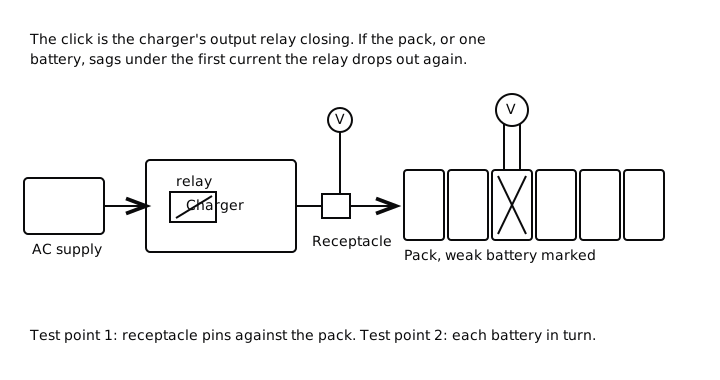
Pack voltage on the edge of the handshake threshold
An automatic cart charger checks battery voltage before it closes its output relay, and the click is that relay pulling in. When the pack sits right at the bottom of the voltage the charger needs to see, the charger connects, finds the voltage sagging under the first bit of current, decides the handshake failed and drops back out. Wake ranges differ by charger family: a lot of 36 volt chargers need to see somewhere above roughly 20 to 28 volts, and a lot of 48 volt chargers somewhere above roughly 28 to 38 volts. Read those as working ranges and check the label or manual for the real number.
3Read the whole pack at the terminals
With the charger unplugged, set the meter to DC volts and read across the pack, most positive post to most negative post.
ExpectedRested and full, a 36 V pack reads about 38.2 V and a 48 V pack about 50.9 V. A pack sitting only just above the wake range, or below it, is the likely reason the charger connects and then lets go
If the pack is simply flat rather than failed, you can raise it back over the threshold: charge each battery on its own with a small charger of the matching voltage, supervised and in a ventilated space, until the pack total is well clear of the handshake range, then let the cart's own charger take over. Confirm the electrolyte covers the plates in every cell first and top up with distilled water where it does not. The multimeter testing guide has the full rested voltage tables and the method.
One failed battery collapsing under the first current
A single dead battery is one of the most common reasons a charger clicks and quits, and it hides well if you only measure the whole pack. At rest the pack total can look nearly normal, because a failed battery still reads a static voltage. Send the smallest current through it and that battery's voltage caves, dragging the pack under the handshake point and forcing the charger out. That is exactly what a repeating click-clack is describing.
4Read each battery in the pack
Measure across the posts of every battery in turn and write the values down in order so you can compare them evenly.
ExpectedRested and full, a 6 V battery reads 6.3 to 6.4 V, an 8 V battery 8.4 to 8.5 V and a 12 V battery 12.6 to 12.7 V. Any battery a volt or more under its neighbors is the unit pulling the pack down
A rested reading only narrows it down; the real test is to read each battery again with the pack under load, because the weak one sags hardest while it is working. The guide on finding the one bad battery walks through that under-load comparison. A battery that fails it is at the end of its life and needs replacing.
A worn receptacle or a poor connection at the plug
The charge plug and the receptacle on the cart carry the full charge current, so a worn contact, a bent pin or a plug that rocks in its socket can drop enough voltage to break the handshake even with a healthy pack. The charger reads a good pack, closes its relay, then watches the voltage at its own output collapse across the bad joint and drops out, giving that same click-clack.
5Compare receptacle voltage with pack voltage
With the charger unplugged from the wall, read DC volts across the pins inside the cart's receptacle, then across the pack terminals.
ExpectedThe two should agree within about 0.1 to 0.2 V. Full voltage at the pack but a low or missing reading at the receptacle pins means a break in the receptacle wiring, its fuse where one is fitted, or the receptacle itself
While you are there, look at the pins and contacts for pitting, discoloration or melted plastic. The charger receptacle guide covers cleaning and replacement.
The charger retrying on its own protection
Chargers cycle their relay by design when internal protection trips. A charger that has overheated, or that senses an out-of-range voltage, closes its relay to test the pack, backs off, waits and tries again, which sounds like a slow click-clack. Many chargers signal this on an error light, so read the pattern against the label or manual before you blame the pack.
6Let the charger cool and read the error light
Unplug the charger, set it somewhere cool and ventilated for half an hour, then plug in again and note any flashing pattern on the indicator.
ExpectedNormal charging returns after cooling: the charger was heat-protecting. A fault pattern that survives the cool-down points to a charger fault or a pack the charger has ruled out of range
If the charger only acts up hot, improve the airflow around it and keep it off carpet and out of direct sun. A charger showing the same fault cold has a genuine problem to track down, either in the pack it is reading or inside the charger.
Charge control faults on Club Car models
On Club Car carts with an onboard computer, the OBC sits in the charge circuit and completes it only when it is satisfied, so a marginal OBC can let the relay click and then refuse to hold. The widely used reset: flip the Tow/Run switch to Tow, disconnect the main negative battery cable for a few minutes, reconnect, switch back to Run and plug the charger in again.
If the reset changes nothing and the same charger holds a steady charge on another vehicle, the OBC, its wiring or the relay it drives is the likely culprit, and that diagnosis belongs with a technician who has the right tools.
A failing charger output stage
A charger with a tired output stage can sense the pack and click its relay but never deliver steady current, so it mimics the pack faults above. It sits low on the list because a pack fault is far more likely, and because the clean way to tell them apart is a swap rather than a guess.
7Try the charger on a known-good cart
Connect the suspect charger to another cart of the same pack voltage and plug type whose batteries are known to be healthy.
ExpectedThe charger settles into a steady charge on the good cart: your charger is fine and the fault is your pack or receptacle. It click-clacks on both: the charger is the problem
Keep the case closed either way. Charger capacitors hold enough energy to deliver a serious shock long after unplugging, and internal repair belongs with a technician.
When to get professional help
Bring in a professional if the per-battery readings show one unit collapsing and you would rather have the pack tested and replaced correctly, if the receptacle contacts show burning, if a Club Car OBC reset does not restore a steady charge, or if the swap test points at the charger. Each is a quick diagnosis with the right equipment, and swapping parts on a hunch, a battery here and a charger there, is the slow, costly route to the same answer.
Common questions
Why does my charger click once and then quit?
The charger sensed the pack, closed its relay to start, then found the voltage sagging under the first current and dropped out. That usually means the pack is on the edge of the charger's handshake voltage or one battery is collapsing. Read the whole pack, then each battery, at the terminals.
Can one bad battery keep the whole pack from charging?
Yes. A single failed battery can read close to normal at rest and then collapse the moment current flows, pulling the pack under the voltage the charger needs and forcing it to abort. You find it by reading each battery under load, which the guide on finding the one bad battery covers.
What voltage does the pack need for the charger to hold?
It depends on the charger family: many 36 V chargers want the pack above roughly 20 to 28 V and many 48 V chargers above roughly 28 to 38 V, with the exact figure on the label or in the manual. A healthy rested pack reads about 38.2 V on a 36 V system and about 50.9 V on a 48 V system, well above the handshake range.
Is it okay to keep plugging it in while it clicks?
A few tries to confirm the pattern are fine, but do not let it cycle for hours. A continuous click-clack means the charger has ruled something out of range, and repeated hard connections are not good for the pack or the receptacle. Diagnose the cause instead of letting it retry.
How do I know if it is the charger or the pack?
Swap test it. Connect your charger to another cart of the same voltage with known-good batteries: if it holds a steady charge there, your charger is fine and the fault is your pack or receptacle; if it click-clacks on both, the charger is at fault.
Can I recover a pack that is only flat?
Often, yes. Charge each battery on its own with a small charger of the matching voltage, supervised and ventilated, until the pack total clears the charger's handshake range, then let the cart charger finish. If one battery will not come up or falls right back, it has failed and recovery will not hold it.
Did this fix it?
Every guide is written from manufacturer service documentation and workshop practice, then reviewed before publication. Read how we write and review our repair guides.