How to test golf cart batteries with a multimeter
Written by the Hawke Electric Vehicles Service Team
Quick answer
You test a golf cart pack with a multimeter on DC volts, reading every battery and the whole pack after it has rested off the charger. Rested and full, a 6 V battery reads about 6.3 to 6.4 V, an 8 V battery 8.4 to 8.5 V and a 12 V battery 12.6 to 12.7 V, and the sign of a failing unit is one battery sitting a volt or more below the rest. Budget a digital multimeter and about 20 minutes.
What this fixes
This procedure resolves the faults covered in these guides.
- Golf cart not charging: causes and fixes
- Golf cart charger clicks but won't charge
- Golf cart charger not working: no power or lights
- Golf cart batteries dying quickly: causes and fixes
- How to test golf cart batteries and find the bad one
- How long do golf cart batteries last?
- Golf cart beeping while driving: what it means
- Golf cart running slow: causes and fixes
- Golf cart repair safety: work safely on your cart
- Golf cart won't start: causes and fixes
- Golf cart turns on but won't move
- Golf cart clicks but won't move
- Golf cart no click, won't move: causes
- How to test a golf cart solenoid
- Golf cart starts then dies: causes and fixes
- Golf cart loses power while driving: fixes
- Golf cart jerks when accelerating: fixes
Tools needed
- Digital multimeter
- Safety glasses
- Insulated gloves
- Work light
- Hydrometer for flooded batteries, optional
Parts needed
- Distilled water, if a cell is found low
- Replacement battery, only if the test condemns one
What this fixes
This procedure tells you whether your batteries are healthy, discharged, or failing, and almost every other battery job leans on it. It clears up the guesswork behind a cart that will not charge, a cart that runs a short way and quits, a pack that bleeds down over a week parked, and a range that has quietly shrunk with age. Instead of swapping the whole pack on a hunch, you use the meter to tell a pack that is merely low from a pack with one bad battery pulling the rest down.
It is the check that comes before you spend anything. One failed battery in a series pack drags the whole set down and wears out the good batteries around it, so catching it early protects them. And if every reading is even and strong, you have proven the pack is fine and can hunt the fault somewhere else.
Tools and parts
Parts
- Distilled water, if a cell reads low on a flooded battery
- Replacement battery of the matching voltage and type, only if the test condemns one
The one tool that counts is a digital multimeter; any basic unit with a DC volts range works, and a hydrometer is a handy extra on flooded batteries but not required. Bring safety glasses, gloves and a work light. This rates as a moderate job, fine for a careful owner, and it runs about 20 to 30 minutes once the pack has rested. The part you cannot hurry is that rest: a reading you can trust needs the pack sitting for a few hours, ideally overnight, after charging or driving.
How to do it
1Let the pack rest before you measure
Unplug the charger and leave the cart parked and undriven for at least a few hours, overnight when you can. A battery fresh off the charger carries a surface charge that reads high and hides a weak unit, and a battery fresh off a drive reads low.
ExpectedNo reading yet; the pack is ready once it has sat undisturbed. A surface charge can add 0.1 to 0.3 V per battery, plenty to mask a problem
2Set the multimeter to DC volts
Turn the dial to DC voltage. On a manual-ranging meter pick the range just above your pack total, such as the 200 V range for a 48 V pack. Black probe in COM, red probe in the volts jack.
ExpectedThe display sits at 0 with the probes apart; a little drift near zero is normal and will not affect your readings
3Read the whole pack first
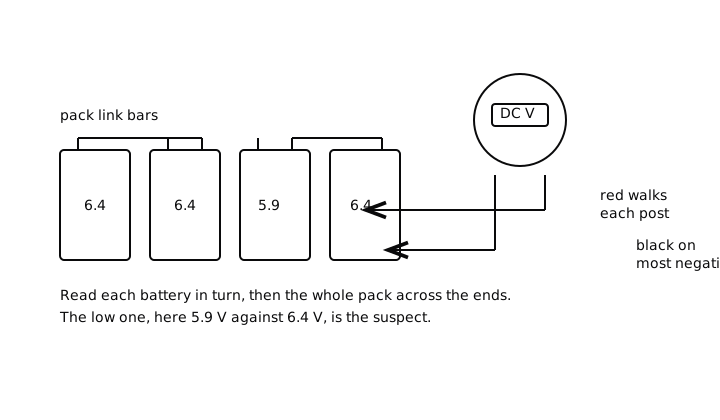
Put the black probe on the most negative terminal of the pack and the red probe on the most positive, following the jumpers from one end of the string to the other so you truly span the whole pack.
ExpectedRested and full, a 36 V pack reads about 38.2 V and a 48 V pack about 50.9 V. Around half charge a 36 V pack reads near 36.5 V and a 48 V pack near 48.7 V. A pack well below nominal is discharged, and the per-battery readings next show whether that is even or down to one unit
4Read each battery in turn and log it
Measure across the two posts of every battery down the string, red on positive and black on negative, and write the number by its position. Go in order so the pattern is easy to see.
ExpectedRested and full, a 6 V battery reads 6.3 to 6.4 V, an 8 V battery 8.4 to 8.5 V and a 12 V battery 12.6 to 12.7 V, since a healthy lead-acid cell holds about 2.12 V and those units carry three, four or six cells. Every battery should land within about 0.2 V of the others
5Compare the numbers and flag the outlier
Scan your list for any battery well under the rest. Small spreads are normal; a wide gap is not.
ExpectedA battery a volt or more below its neighbors, say a 12 V unit at 10.5 V where the others read 12.6 V, is the prime suspect and is probably dragging the whole pack down
6Load-test a suspect to confirm it
A resting number can look fine and then collapse under load. With the pack charged, put a known load on it by switching the lights on or driving the cart a short way on level ground, then read the suspect battery and a good one during the load.
ExpectedUnder load every battery dips a little, but a failing one dips far more: a suspect that stays within a few tenths of a volt of its neighbors is sound, while one that falls a volt or more below them under the same load is a confirmed weak battery
Check it worked
7Confirm you have a clear verdict
Read back your notes. Either every battery is even and near its full resting number, or one or more sit clearly low both at rest and under load.
ExpectedAn even, healthy set clears the pack and sends you elsewhere. A single low battery, confirmed under load, is your fault; replace it, and on an older pack expect the rest to have limited life left because they have been working harder to make up for it
When to get professional help
Call a technician if you find one weak battery in an otherwise good pack and want a matched replacement fitted and the set balanced, if several batteries read low and you are weighing a full pack replacement, or if the readings are even and healthy yet the cart still acts up, which points at the charger, wiring or controller rather than the batteries. A meter shows the state of the pack; it does not always show the reason, and a technician can close that gap before you buy parts on a guess.
Common questions
What should each battery read when fully charged?
Rested and full, a 6 V battery reads 6.3 to 6.4 V, an 8 V battery 8.4 to 8.5 V and a 12 V battery 12.6 to 12.7 V. A healthy lead-acid cell sits near 2.12 V, and those batteries hold three, four and six cells.
What should the whole pack read?
A fully charged, rested 36 V pack reads about 38.2 V and a 48 V pack about 50.9 V. Near half charge a 36 V pack sits around 36.5 V and a 48 V pack around 48.7 V. Anything under those numbers means the pack is discharged rather than automatically faulty.
Do I really have to wait before testing?
Yes. Straight off the charger a battery holds a surface charge that reads high and can hide a weak unit, and right after a drive it reads low. Rest the pack a few hours, overnight when you can, for a number you can rely on.
Can a battery read the right voltage and still be bad?
Yes, which is why the load test is here. A worn battery can recover a near-normal resting voltage and then collapse the second it has to deliver current. Reading it under load, lights on or during a short drive, separates a truly healthy battery from one that only looks healthy at rest.
How much spread between batteries is too much?
Small spreads up to about 0.2 V across the set are normal. A battery a volt or more below its neighbors is the sign of a failing unit dragging the pack down, and you should confirm it under load before replacing it.
Replace one bad battery or the whole pack?
On a young pack a single matched replacement can work out. On an older pack the surviving batteries have already worked harder to cover the weak one, so one new battery often gets outlived fast by the tired units around it, and a full set gives more even, longer service. The age and the spread of your readings make the call.
Did this fix it?
Every guide is written from manufacturer service documentation and workshop practice, then reviewed before publication. Read how we write and review our repair guides.