Golf cart batteries dying quickly: causes and fixes
Written by the Hawke Electric Vehicles Service Team
Quick answer
A golf cart that has lost half its range and sags under load has usually reached the end of its battery life, or has one weak battery dragging the whole pack down. Before you condemn the pack, rule out the range thieves that are not the batteries: dragging brakes, soft tires and corroded cables. Start with a rested pack voltage, then test each battery.
Tools needed
- Digital multimeter
- Hydrometer
- Tire pressure gauge
- Safety glasses
- Insulated gloves
- Work light
Confirm the symptom
This guide is for a cart that still drives but goes noticeably less distance than it used to on a full charge, and that sags or slows as the charge drops. Range loss is gradual when a pack ages evenly and more sudden when one battery fails or something starts dragging, so note whether the drop crept in over a season or showed up within a week.
If the cart will not charge at all, you are on the wrong guide; read Golf cart not charging. If it charges fully but feels slow everywhere with no loss of range, the cause is more likely dragging brakes, tire pressure or a speed setting, covered in the running-slow guides. If it only struggles on hills, see the slow-uphill guide. This guide assumes the range itself has shrunk.
1Measure the rested pack after a full charge
Charge the pack fully, let it rest off the charger for a few hours, then read across the whole pack with a multimeter on DC volts.
ExpectedA healthy rested 36 V pack reads about 38.2 V and a 48 V pack about 50.9 V. A pack that cannot reach these figures even after a full charge is losing capacity
2Note how far the range has actually fallen
Drive a known short route or watch the state-of-charge behavior, and compare it with how the cart ran when new.
ExpectedA pack down to roughly half its old range, or one that dives on the meter under load, has a real capacity problem worth chasing rather than a one-off flat
What causes it
| Cause | How common | How to confirm | Fix |
|---|---|---|---|
| Aged pack that has lost capacity | very common | Full charge then rested pack voltage; hydrometer or load test shows tired cells | How to test golf cart batteries with a multimeter |
| One weak battery dragging the pack down | very common | Read each battery rested, then under load; the weak one sags most | How to test golf cart batteries with a multimeter |
| Dragging brakes or a binding motor brake | common | Raise each wheel and spin it; feel for drag and check for hot hubs after a drive | |
| Low tire pressure | common | Check every tire against the pressure on the sidewall or in the manual | |
| Corroded or loose battery cables and terminals | common | Inspect for crust and heat marks; feel for warm connections after a drive | |
| Chronic undercharging or low electrolyte | occasional | Check the charge routine and top up cells with distilled water as needed |
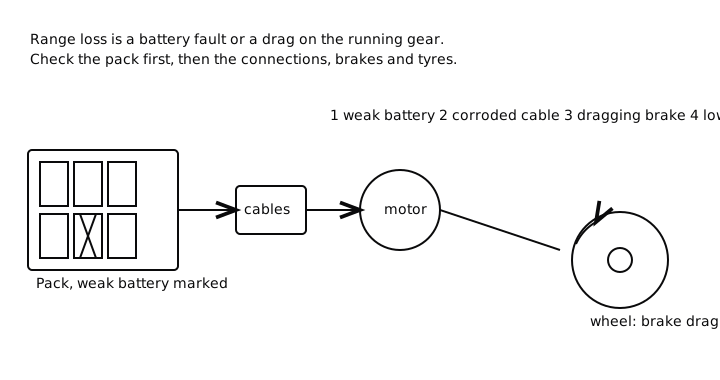
An aged pack that has lost capacity
Lead-acid batteries wear out whether or not anything else is wrong with the cart. A typical lead-acid pack gives about four to six years of regular use before its capacity drops far enough to notice, and range loss is the first sign because a tired pack simply holds less energy. The pack can still charge to a healthy rested voltage and yet run flat quickly, because voltage reports the state of charge, not how much charge the pack can hold.
3Confirm capacity, not just voltage
After a full charge and a rest, read the rested pack voltage, then check specific gravity with a hydrometer on filler-cap batteries, or set up a load test as described in the load-testing guide.
ExpectedHealthy rested voltage but weak specific gravity, or a pack that collapses on a load test, confirms tired cells rather than a single fault. Sealed batteries cannot take a hydrometer, so use the load test
When the whole pack is worn, the fix is a full set of matched batteries, not one or two. Mixing new batteries with old ones drags the new units down to the level of the pack, which is why replacing a single battery in an aged set rarely restores range and often shortens the life of the new one. The guide on how long batteries last covers the replacement decision in more detail.
One weak battery dragging the pack down
A pack is only as strong as its weakest battery, and a single failing unit can steal range while the others are still healthy. At rest the weak battery may read close to the rest, which is why measuring the whole pack alone can miss it. The failing battery shows itself under load, when its voltage sags far more than its neighbors.
4Compare each battery rested and under load
Read across the posts of every battery at rest and note the values, then read each one again while a helper holds the pedal to put the pack under load.
ExpectedRested and full, a 6 V battery reads 6.3 to 6.4 V, an 8 V battery 8.4 to 8.5 V and a 12 V battery 12.6 to 12.7 V. The battery that sags hardest under load is the weak one; the full method is in the guide on finding the one bad battery
One failed battery on an otherwise young pack can be replaced, ideally with a matched unit of the same make, age and rating where you can get it. On an old pack, a single weak battery usually means the rest are close behind, so a full-set replacement is often the smarter spend.
Dragging brakes or a binding motor brake
Not every range problem is a battery problem. Brakes that drag make the motor fight the whole time the cart is moving, which drains the pack faster and leaves the hubs hot. The usual causes are over-tightened brake adjusters, seized cables and weak return springs, and on some models an electromagnetic motor brake that is not releasing all the way.
5Spin each wheel and check for drag
With the Tow/Run switch in Tow, raise each wheel in turn on jack stands and spin it by hand, comparing how freely each turns. After a normal drive, carefully feel each hub for heat.
ExpectedA free wheel spins several turns and slows smoothly; a wheel that stops almost at once, or a hub clearly hotter than the others, points to a dragging brake at that corner
Dragging brakes are covered fully in the brakes-dragging guide, which walks through backing off the adjustment, freeing a seized cable and checking the return springs. Fixing a drag often restores a surprising amount of range, because the loss is constant whenever the cart moves.
Low tire pressure
Soft tires raise rolling resistance, so the motor pulls more current to cover the same ground and the pack runs down sooner. It is among the least costly range faults to put right and one of the most overlooked, because a tire can look fine and still be well down on pressure.
6Check every tire against its rated pressure
With the tires cold, check each one with a gauge against the pressure printed on the sidewall or given in the manual, and inflate any that are low.
ExpectedAll tires at their rated pressure roll freely; a tire well below its figure has been costing range and stressing the sidewall. The tire pressure guide gives the correct settings by tire type
Keep the tires matched in condition as well as pressure. A worn or under-inflated tire on one corner also pulls the steering, so if the cart wanders as well as fading, check pressures before anything else.
Corroded or loose battery cables and terminals
Every connection in the pack carries the full drive current, so a corroded or loose terminal adds resistance that wastes energy as heat and drops the voltage the motor actually sees. The tell-tale signs are green or white crust on the posts, discolored or melted insulation, and connections that feel warm after a drive.
7Inspect and feel the connections
With the pack at rest, inspect every terminal and interconnect for corrosion and looseness, then after a short drive carefully feel each connection for warmth.
ExpectedClean, tight, cool connections are fine; crust, heat or a warm joint means resistance is stealing range and needs cleaning and tightening
Clean corroded terminals, refit them tight and protect them, as covered in the terminal-corrosion guide. A cable that has overheated at the post may be damaged inside its insulation and is covered in the hot-cable guide; do not just retighten a cable that has been running hot.
Chronic undercharging or low electrolyte
How a pack is charged and watered decides how long it holds its range. Using the cart again and again without charging it fully, or letting the electrolyte fall below the plates, damages lead-acid batteries and shows up as shrinking range long before the pack fails outright. This cause lands last because it is a habit rather than a single broken part, but it quietly ages every other cause on the list.
8Check the electrolyte and the charge habit
With the pack rested, confirm the electrolyte covers the plates in every cell and top up with distilled water where it does not, and review whether the cart is charged fully after each use.
ExpectedPlates covered and a full charge after every use is correct; exposed plates or routine part-charging is aging the pack and eating into range
Top up cells after charging, not before, because the electrolyte level rises as the battery charges. The battery watering guide covers how and when in full. Getting the charge and watering routine right will not revive a worn-out pack, but it protects a healthy one.
When to get professional help
Bring in a professional if the per-battery readings show one or more units collapsing under load and you would rather have the pack load-tested and replaced correctly, if a hub stays hot and you cannot free the drag safely, or if the range loss does not add up after the checks above. A technician can load-test the pack and check the brakes and running gear in one visit, which beats replacing batteries on a guess and finding the drag was the real thief.
Common questions
How long should a golf cart battery pack last?
A typical lead-acid pack gives about four to six years of regular use before its capacity drops far enough to shorten range noticeably. Life depends on how the pack is charged, watered and stored, so a neglected pack fades sooner and a well-kept one lasts longer.
Can one bad battery ruin the whole pack's range?
Yes. A pack is only as strong as its weakest battery, so one failing unit sagging under load pulls the whole pack down and cuts range even when the others are healthy. Find it by reading each battery under load, as covered in the guide on finding the one bad battery.
Why does my range drop but the pack still charges fully?
Voltage shows the state of charge, not the capacity. An aged pack can charge to a healthy rested voltage, about 38.2 V on a 36 V system or 50.9 V on a 48 V system, and still run flat quickly because it holds less energy than it used to. A hydrometer or load test confirms the lost capacity.
Could my brakes or tires be draining the batteries?
Indirectly, yes. Dragging brakes make the motor work harder the whole time the cart moves, and soft tires raise rolling resistance, so both drain the pack faster and read as poor battery life. Spin each wheel for drag and check every tire pressure before condemning the batteries.
Is it worth replacing just one weak battery?
Only on a young pack. On an old set, a new battery is dragged down to the level of the tired ones and rarely restores range, so a full matched set is usually the smarter spend. On a young pack with a single failure, a matched replacement can be reasonable.
Does cold weather reduce range?
Yes. Lead-acid batteries deliver less capacity in the cold, so winter range is normally shorter and recovers as it warms. If the loss carries on into warmer weather, treat it as a real fault and work through the checks in this guide.
Did this fix it?
Every guide is written from manufacturer service documentation and workshop practice, then reviewed before publication. Read how we write and review our repair guides.